
The data had hardly started coming through the pipeline when astronomers made the first Frontier Field discovery: a supernova in the galaxy cluster MACSJ0717, one of the first of the Frontier Fields to be imaged.
The Frontier Fields designation for this object is SN HFF13Zar, and its nickame is “SN Zara.”
Supernovae discovery is an offshoot of Frontier Fields science because Hubble will be revisiting many of these fields several times over the next three years, allowing astronomers to compare recent images with older ones, and look for things that are different.
The supernova is located 1.73 arcmin from the center of the MACSJ0171 cluster and is a whopping 23.53 (+- 0.05) magnitude.
I say whopping, but big numbers on the magnitude scale mean an object is very, very dim. This is definitely a faint supernova, but not out of the ordinary in terms of what Hubble can see. Hubble can see things as faint as 31st magnitude, which is slightly fainter than objects that can be viewed by the best ground-based telescopes.
Without getting too crazy into the magnitude scale topic, suffice it to say for our purposes that
One magnitude thus corresponds to a brightness difference of exactly the fifth root of 100, or very close to 2.512 — a value known as the Pogson ratio. Source: Sky and Telescope
Aren’t you glad you asked?
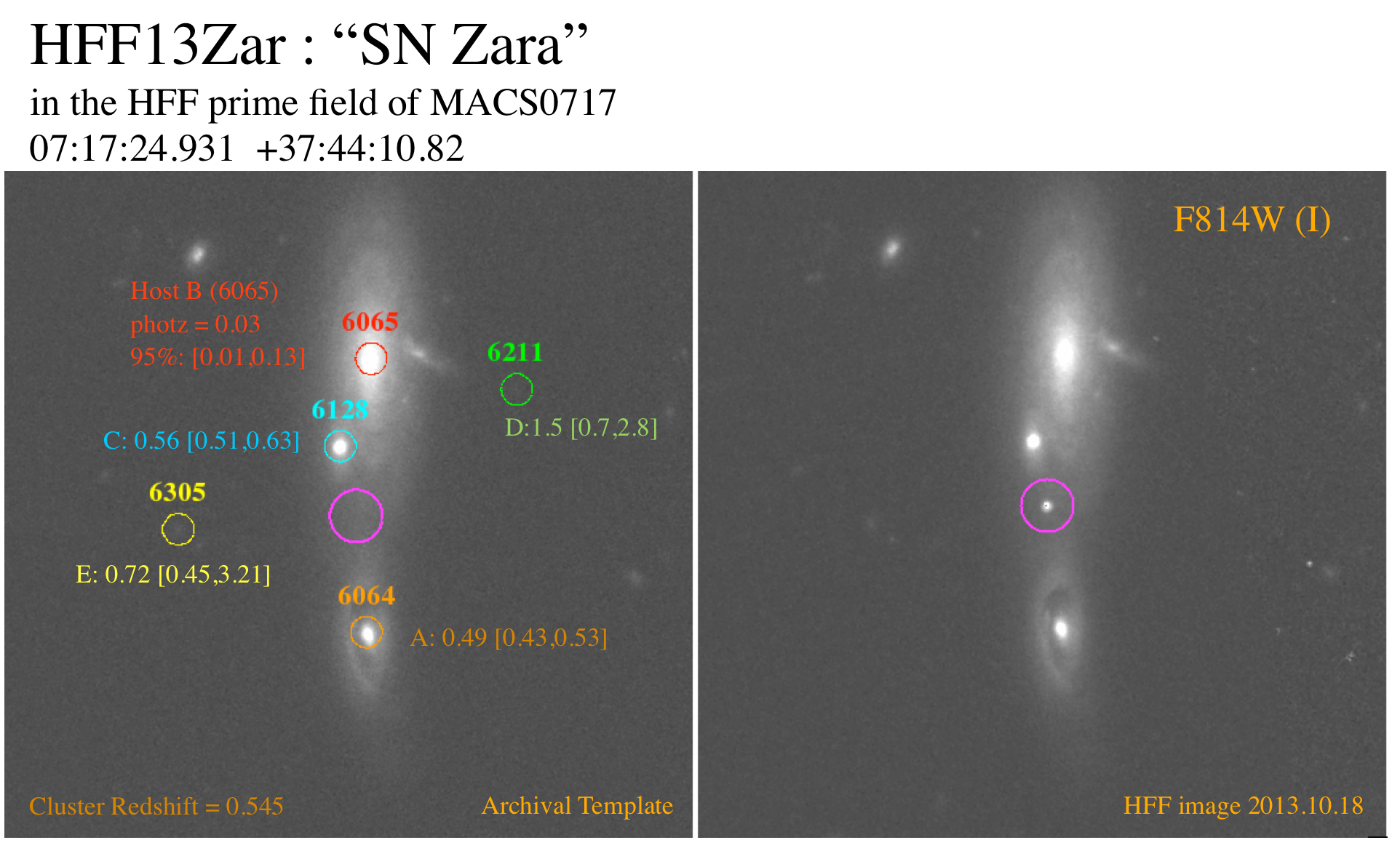
So the supernova is faint, but Hubble can see it without problems, as you can tell from the right panel, in which a purple circle marks the supernova. The left panel in this image is a compilation of observations taken in 2006 and prior with Hubble’s Advanced Camera for Surveys (ACS).
SN HFF12Zar was discovered using the F814W filter, known as the i band in the ACS.
The supernova’s home is still unknown — it could have occurred in one of three potential galaxies within 5 arcsec of the stellar explosion. These galaxies are labelled in the above image as A (orange), B (red) and C (light blue).
The other circles, D (green) and E (yellow) are other galaxies probably not associated with the supernova.
The redshift of the galaxy cluster is z=0.5458 (~10 billion LY away) and according to Dr. Steven Rodney (JHU), Dr. Jennifer Lotz (STScI), and Dr. Louis-Gregory Strolger (STScI), if the supernova is associated with host galaxy candidates A or B, it is a foreground object. If it’s associated with host galaxy candidate C, then it could plausibly be a SN from a galaxy in the outskirts of the cluster.
We’ll be revisiting this cluster again with Hubble in December 2013, as part of the Grism Lens Amplified Survey from Space (GLASS) proposal, but this supernova will probably be faded by the time Hubble looks this way again. However Steve Rodney and Lou Strolger have a program to search the Frontier Fields data for new supernovae as it comes in; if they find something that is potentially very interesting — very distant and/or lensed by the cluster, they will trigger extra Hubble observations of the supernovae to determine the type of supernova and exact distance.


 Frontier Fields