Frontier Fields in Two Minutes

The Frontier Fields project is an ambitious, multi-year cosmology research project using Hubble and many other telescopes. Describing the astronomy motivation, science concepts, planning, coordination, and execution is a long and daunting task. The Principal Investigator, Jennifer Lotz, recently gave a public-level presentation that was an hour long, with much of her discussion necessarily condensed.

Now, folks don’t always have that kind of time to spend learning about a new project. What about the short version: the so-called elevator pitch?

To address that need, we created a two-minute video overview of the Frontier Fields. We trimmed the astronomical story to its essentials, gathered and developed scientific visuals, and attempted to express it it all in just nine sentences.

The video below was part of our press release at the American Astronomical Society winter meeting in January 2014. It won’t make you a cosmology expert, but it will provide the essential character of one of the most important projects amongst Hubble’s current programs. I directed (and narrated) this video, and would welcome any comments or questions.

As for all those scientific details that we glossed over or skipped, well, that’s one of the main motivations of this blog. Stay tuned.

Frontier Fields: Exploring the Depths of the Universe

This video presents an overview of the Frontier Fields project. While Hubble has a celebrated history of deep field observations, astronomers can use massive galaxy clusters as gravitational lenses to see a little farther into space and a little further back in time. This ambitious, community-developed project is a collaboration among NASA’s Great Observatories to probe the earliest stages of galaxy development. Initial data from this multiyear effort was presented at the American Astronomical Society Meeting in January 2014.

Credit: NASA, ESA, and F. Summers, B. Lawton, M. Lussier, G. Bacon, and D. Coe (STScI)

Music: “The Moments of Our Mornings” (K. Engel)/CC BY-NC 3.0

Searching for Cosmic Dawn

Today’s guest post is by Hubble Space Telescope astrophysicist Dr. Jennifer Lotz.

How deep can we go? What is the faintest — and possibly most distant — galaxy we can see now with the Hubble Space Telescope? This is the challenge taken up by the Frontier Fields, a new campaign to see deeper into the universe than ever before.

It is thrilling to push past the limits of our knowledge of the universe. But the Frontier Fields are motivated by more than record-breaking. With a great deal of effort, Hubble is starting to capture light from galaxies that shows them as they appeared in the first few hundred million years of the universe. Sometime between the Big Bang — more than 13 billion years ago —  and today, the Universe evolved from a hot, smooth sea of protons, electrons, and dark matter to a collection of billions of individual galaxies separated from each other by vast regions of mostly empty space. Within our own Milky Way galaxy are billions of stars forming out of clouds of gas, with planets surrounding almost every star. How did these “billions upon billions” come to be?

Because the speed of light is finite, astronomy is the only science in which it is possible to look back in time and directly observe the formation of galaxies and stars. The farther away an object is, the longer it takes for its light to reach us. Therefore, we see very distant objects as they were in the past — sometimes billions of years in the past. We call this “look-back time.”

Very distant galaxies with look-back times of 13 billion years or more appear very, very faint. Just how faint? The faintest objects that the Hubble Space Telescope has seen are galaxies whose light we have collected by looking a one small piece of sky for hundreds of hours — the Hubble Ultra Deep Field. Those objects are some 4 billion times fainter than the faintest star the human eye can see.

But it turns out that this may not be faint enough to see the era of cosmic dawn, when the lights from the first stars and galaxies turned on. Even with the Hubble Ultra Deep Field, we have just a handful of galaxies detected at these early times. Even though they appear very faint to us, these early galaxies we have seen are likely to be the biggest and brightest objects around at that time. In order to understand how and when galaxies like our own Milky Way first formed, we need to peer even deeper into the early universe.

Illustration of the depth by which Hubble imaged galaxies in prior Deep Field initiatives, in units of the Age of the Universe. The goal of the Frontier Fields is to peer back further than the Hubble Ultra Deep Field and get a wealth of images of galaxies as they existed in the first several hundred million years after the Big Bang. Note that the unit of time is not linear in this illustration. Illustration Credit: NASA and A. Feild (STScI).

Illustration of the depth by which Hubble imaged galaxies in prior Deep Field initiatives, in units of the Age of the Universe. The goal of the Frontier Fields is to peer back further than the Hubble Ultra Deep Field and get a wealth of images of galaxies as they existed in the first several hundred million years after the Big Bang. Note that the unit of time is not linear in this illustration. Illustration Credit: NASA and A. Feild (STScI).

The James Webb Space Telescope, with its much larger light-collecting area and infrared sensitivity, is designed to study these early galaxies in great detail.  But JWST is still years away, and our knowledge about the first galaxies is extremely limited. By using a trick from Einstein’s theory of general relativity, Hubble is attempting to get a sneak peek at these very faint and distant galaxies.
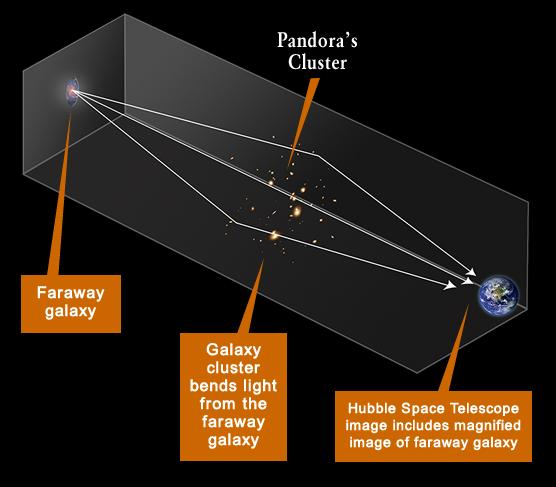
Illustration of how galaxy clusters can bend and redirect the light from distant background galaxies. Not only is the galaxy's light bent back in our direction so that Hubble can view it, but it is also magnified. This technique provides a means by which we can detect faint distant galaxies that would otherwise be out of reach of Hubble's capabilities. Illustration Credit: A. Feild (STScI)

Illustration of how galaxy clusters can bend and redirect the light from distant background galaxies. Not only is the galaxy’s light bent back in our direction so that Hubble can view it, but it is also magnified. This technique provides a means by which we can detect faint distant galaxies that would otherwise be out of reach of Hubble’s capabilities. Illustration Credit: A. Feild (STScI)

The most massive objects in the Universe — very massive clusters of galaxies — bend space in such a way that light rays passing by a cluster will also be bent, much in the way light passing through a telescope is bent. This is called “gravitational lensing,” and these clusters act as nature’s telescope, magnifying and stretching the light from those galaxies located behind the clusters.

The Frontier Fields is observing six of these massive clusters of galaxies. Due to the boost from the cluster lensing, the images obtained by the Frontier Fields will probe galaxies ten to twenty times fainter than the objects seen in the Hubble Ultra Deep Field. In combination with six additional “parallel” fields, areas near the Frontier Fields regions that lack massive galaxy clusters but can be observed simultaneously to obtain additional “deep field” images, these images are expected to give us a better understanding of how and when galaxies like our Milky Way formed.

The very first data from the first cluster — Abell 2744 — has been taken:
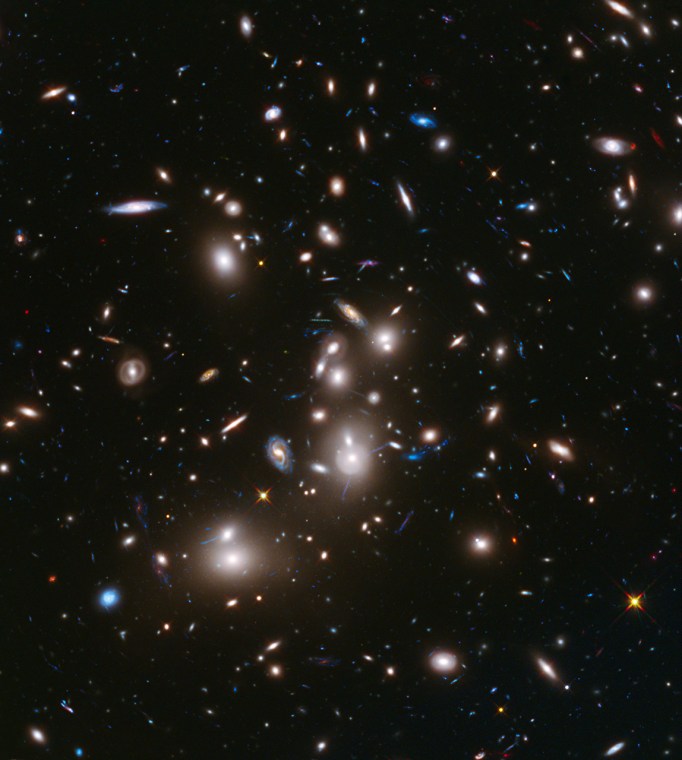
The immense gravity in this foreground galaxy cluster, Abell 2744, warps space to brighten and magnify images of far-more-distant background galaxies as they looked over 12 billion years ago, not long after the big bang. This is the first of the Frontier Fields to be imaged.

The immense gravity in this foreground galaxy cluster, Abell 2744, warps space to brighten and magnify images of far-more-distant background galaxies as they looked over 12 billion years ago, not long after the Big Bang. This is the first of the Frontier Fields to be imaged. Credit: NASA, ESA, and J. Lotz, M. Mountain, A. Koekemoer, and the HFF Team (STScI)

As have the first observations of a parallel field:
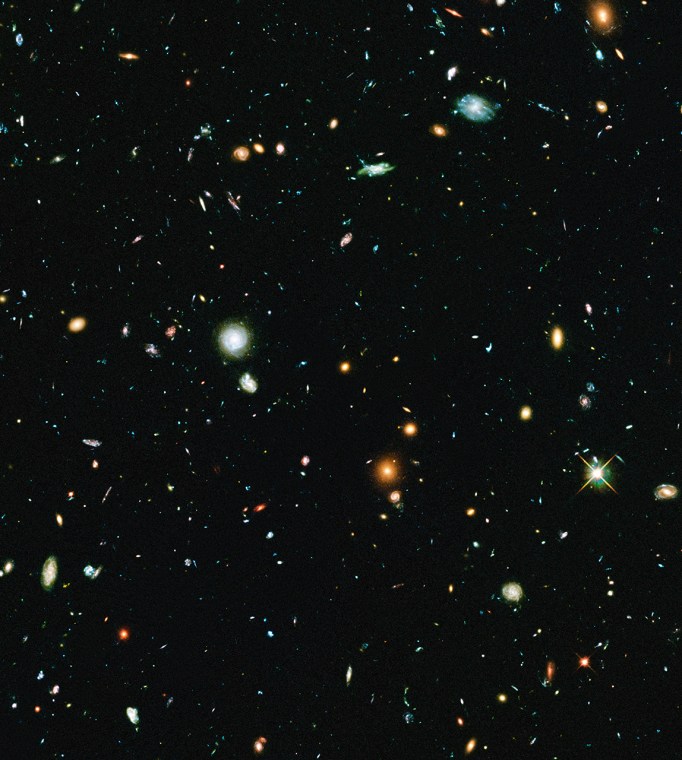
In this "parallel field" to Abell 2744, Hubble resolves roughly 10,000 galaxies seen in visible light, most of which are randomly scattered galaxies. The blue galaxies are distant star-forming galaxies seen from up to 8 billion years ago; the handful of larger, red galaxies are in the outskirts of the Abell 2744 cluster.

In this “parallel field” to Abell 2744, Hubble resolves roughly 10,000 galaxies seen in visible light, most of which are randomly scattered galaxies. The blue galaxies are distant star-forming galaxies seen from up to 8 billion years ago; the handful of larger, red galaxies are in the outskirts of the Abell 2744 cluster. Credit: NASA, ESA, and J. Lotz, M. Mountain, A. Koekemoer, and the HFF Team (STScI)

While astronomers work to understand these first images,   Hubble is moving on to the next cluster — MACS0416-2403. Expect many more beautiful and deep images over the next few years, and a new understanding of cosmic dawn.

Cosmic Archeology

Today’s guest post is by Dr. Mario Livio, Hubble astrophysicist and author of the blog “A Curious Mind.” A version of this post appeared previously on Dr. Livio’s blog.

During the Christmas season of 1995, the Hubble Space Telescope was pointed for 10 consecutive days at an area in the sky not larger than the one you would see through a drinking straw. The region of sky, in the Ursa Major constellation, was selected so as to be as “boring” as possible — empty of stars in both our own Milky Way galaxy and in relatively nearby galaxies. The idea was for Hubble to take as deep an image of the distant universe as possible. The resulting image was astounding.  With very few exceptions, every point of light in this image is an entire galaxy, with something like 100 billion stars like the Sun.

Image

The original Hubble Deep Field image.

Detailed analysis revealed that the very remote galaxies were physically smaller in size than today’s galaxies, and that their morphologies were more disturbed. Unlike the grand-design spirals or smooth elliptical shapes that we see in relatively close galaxies, the distant objects look like train wrecks. Both of these observations fit nicely into the idea that galaxies evolve largely by “mergers and acquisitions.” Small building blocks merge together to form larger ones, or cold flows of dark matter along dense filaments fuel the growth. What we see in the distant past are those interacting—and hence smaller and less regular in shape—building blocks.

Since then, Hubble observed even deeper, producing the “Hubble Ultra Deep Field” in 2004, and then in 2009 an image that included infrared observations taken with the new Wide Field Camera 3. This observation allowed astronomers to glimpse the universe at its infancy, when it was less than 500 million years old (the universe today is 13.8 billion years old). The Deep Field observations have also enabled researchers to reconstruct the history of global cosmic star formation. We now know that about 8 billion years ago the universe reached its peak in terms of the new star-birth rate, and that rate has been declining ever since — our universe is past its prime.

 Image

This tiny object in the Hubble Ultra Deep Field is a compact galaxy of blue stars that existed 480 million years after the Big Bang. Its light traveled 13.2 billion years to reach Hubble.

The Chandra X-ray Observatory has created its own Deep Field observations, discovering hundreds of low-luminosity active galactic nuclei, where disks feed mass onto central black holes, and emit copious x-ray radiation.

Infrared observations with the Spitzer Space Telescope completed the picture of the deepest images of the cosmos to date. Together, Hubble, Chandra, and Spitzer have created a detailed tapestry of a dynamic, evolving universe in which some two hundred billion galaxies are within the reach of our present telescopes.

Currently, Hubble is engaged in observing six new deep fields, each one centering on a galaxy cluster whose gravity can deflect, multiply, and magnify the light from more distant objects (the effect is known as “gravitational lensing”). In parallel, Hubble will also observe six deep “blank” fields. The goal is to use those so-called “Frontier Fields” to reveal populations of fainter galaxies, and to characterize the morphologies of distant star-forming galaxies.

The first of these super-deep views of the universe has already revealed almost 3000 of previously unseen, distant galaxies.

To see the very first galaxies that formed in our universe, we will have to await the James Webb Space Telescope, on schedule for launch in 2018. From a cosmic perspective, new discoveries are just around the corner!

Cluster and Parallel Fields: Two for the Price of One

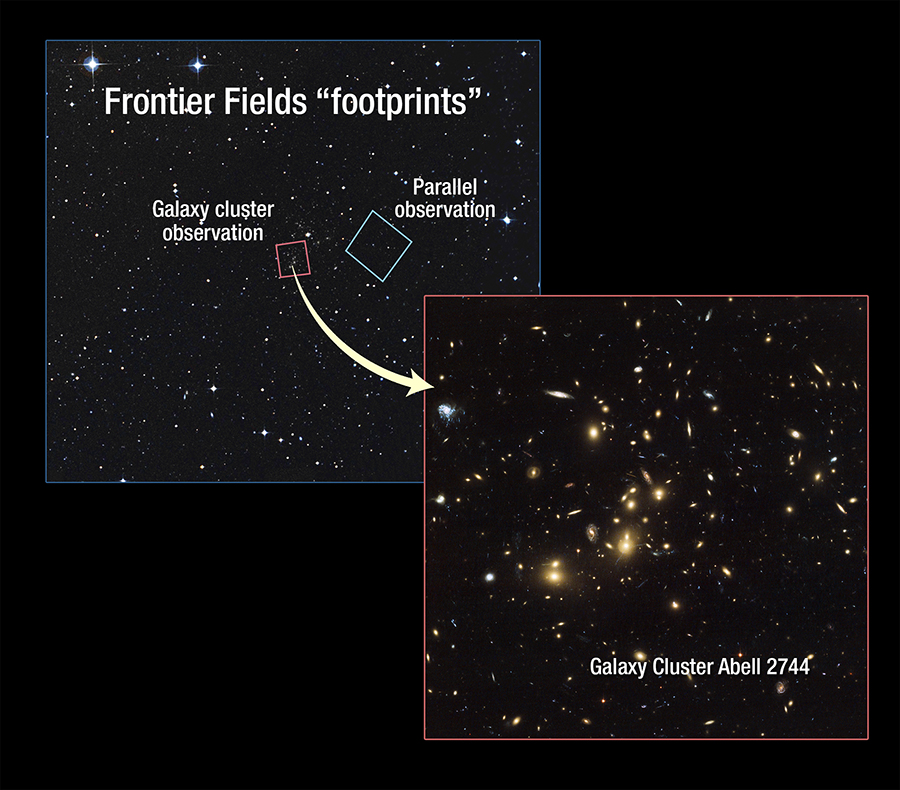
Hubble is doing double-duty as it peers into the distant universe to observe the Frontier Fields. While one of the telescope’s cameras looks at a massive cluster of galaxies, another camera will simultaneously view an adjacent patch of sky. This second region is called a “parallel field”—a seemingly sparse portion of sky that will provide a deep look into the early universe.

A picture of the galaxy cluster field and the parallel field

This image illustrates the “footprints” of the Wide Field Camera 3 (WFC3) infrared detector, in red, and the visible-light Advanced Camera for Surveys (ACS), in blue. An instrument’s footprint is the area on the sky it can observe in one pointing. These adjacent observations are taken in tandem. In six months, the cameras will swap places, with each observing the other’s previous location.

Many people are familiar with Hubble’s deep field images, where the telescope stared at what appeared to be relatively empty areas of the sky for long periods of time. Instead of a vast sea of blackness, what astronomers saw in these long exposures were thousands upon thousands of galaxies of all shapes and sizes.

But these deep fields covered just a small fraction of the area of the full moon on the sky. Do they really reflect what our universe looks like, or are these unusual regions? The truth is, astronomers just don’t know. That’s why they are adding to their knowledge by studying the six “parallel” deep fields in various locations across the sky. Whether or not they find similar galaxy-rich regions, they will learn something interesting about our universe.

Hubble simultaneously uses the Advanced Camera for Surveys (ACS) for visible-light imaging, and Wide Field Camera 3 (WFC3) for its infrared vision. So the infrared camera could observe the cluster while the visible-light camera focuses on the parallel field.

Light paths from fields to Hubble instruments

This diagram shows the light paths that originate with the galaxy cluster field and the neighboring parallel field. The light from the galaxy cluster field (red) is imaged with the Hubble’s Wide Field Camera 3 (WFC3) infrared detector, while the light from the parallel field (blue) is imaged with the visible-light Advanced Camera for Surveys (ACS). Hubble’s entire field of view is shown on the left side of the diagram. It includes the “footprints” of ACS (red) and WFC3 (blue), as well as those of the fine guidance sensors (FGSs), which are the three, white wedges on the outside, and everything in between them.

Six months later, the Earth will be at the opposite side of the sky in its yearly orbit around the Sun. The telescope, which is powered by solar arrays, has also pivoted 180 degrees to achieve the optimal orientation to illuminate the arrays. This opposite rotation means the cameras will effectively “swap places,” with each camera now observing the other’s previous location. Now the visible-light camera views the cluster while the infrared camera images the parallel field.

Detailed view of galaxy cluster Abell 2744

This diagram shows a detailed view of galaxy cluster Abell 2744, one of two massive galaxy clusters being imaged in the first year of Frontier Fields.

For each of the six cluster and six parallel fields, astronomers will have both infrared and visible-light observations. This will allow them to create more detailed, overlapping and complete images.

Over three years, 840 orbits will be devoted to these 12 fields. That’s about 2 million seconds of Hubble time. These data are taken in 15-20 minute exposures, and they come down to the ground as digital files. These images are then stitched together to create mosaics. The resulting views will give us new insight into the early universe.

Hubble's field of view and the footprints of its instruments

This illustration shows the “footprints” of all the instruments in Hubble’s field of view. These include the fine guidance sensors (FGSs), the Near Infrared Camera and Multi-Object Spectrometer (NICMOS), the Space Telescope Imaging Spectrograph (STIS), the Cosmic Origins Spectrograph (COS), the Wide Field Camera 3 (WFC3), and the Advanced Camera for Surveys (ACS), which includes the Solar Blind Channel (SBC). WFC3 and ACS are the two instruments involved in the Frontier Fields program.