
Light Detectives: Using Color to Estimate Distance

Distances are notoriously difficult to measure in astronomy. Astronomers use many methods for estimating distances, but the farther away an object is, the more uncertain the results. Cosmological distances, distances on the largest scales of our universe, are the most difficult to estimate. To measure the distances to the farthest galaxies, those gravitationally lensed by massive foreground galaxy clusters, astronomers really have their work cut out for them.

If a massive stellar explosion, known as a supernova, happens to go off in a galaxy and we catch it, then we can use the “standard candle” method of computing the distance to the galaxy. Supernovae are expected to be discovered in the Frontier Fields, but not at the numbers that will help us find distances to most of the galaxies in the images. Without these standard candles, astronomers must use other means to estimate distances.

A Spectrum is Worth a Thousand Pictures

One of the more accurate methods for measuring the distance to a distant galaxy involves obtaining a spectrum of the galaxy. Getting a galaxy’s spectrum basically means taking the light from that galaxy and breaking it up into its component colors, much like a prism breaks up white light into the rainbow of visible colors. By comparing the brightness of light at each component color, a spectrum can give us a wealth of information. This can include detailed information about a galaxy’s composition, temperature, and how fast it is moving relative to us. Because the universe is expanding, we observe most galaxies, and all distant galaxies, to be moving away from us.

When looking at a distant galaxy’s spectrum, the expansion of the universe causes the component colors in the spectrum to be stretched to longer wavelengths. For visible light, red has the longest wavelengths, which leads to the term ‘redshift’. This cosmological redshift can be accurately measured from a spectrum. Astronomers then use mathematical models of the expansion rate of our universe to convert the measured redshift into an estimate of distance. Larger values of redshift correspond to larger distances.

This video, developed by the Office of Public Outreach at the Space Telescope Science Institute, gives a demonstration of how light is redshifted as it travels through the expanding universe. Here, the lightbulb stands in place of a galaxy. As the universe expands, it stretches the light traveling through the universe, increasing the light’s wavelength. As the wavelength increases, it becomes more red. Light traveling longer distances through the universe will be stretched/reddened more than light traveling short distances. This is why astronomers use instruments sensitive to redder light, including infrared light, when they attempt to observe the light from very distant galaxies. Watch this video on Youtube.

Larger redshifts not only correspond to larger distances, but they also correspond to earlier times in our universe’s history. This is because light takes time to travel to us from these distant galaxies. The more distant the galaxy, the longer the light has been traveling before we intercept it with sensitive telescopes, like Hubble.

Assuming typical contemporary mathematical models, the universe is about 13.8 billion years old. Galaxies at a redshift of 1 are seen as they existed when the universe was about 6 billion years old.  Galaxies at a redshift of 3 are seen as they existed when the universe was about 2 billion years old. Galaxies at a redshift of 6 are seen as they existed when the universe was about 1 billion years old.  Galaxies at a redshift of 10 are seen as they existed when the universe was only about 500 million years old.

It is notoriously difficult to obtain a spectrum of a very distant galaxy.  They are very faint, and an accurate spectrum relies on obtaining a lot of light.  One is, after all, taking what little light you get and breaking it up further into the component colors, meaning that you start with little light and get out even less light at each component color.  Getting enough light to take an accurate spectrum of a distant galaxy requires very lengthy observations with sensitive telescopes.  This is not always feasible.

Redshifts measured via spectra are called spectroscopic redshifts. Many of the nearer galaxies in Abell 2744 have measured spectroscopic redshifts. There will likely be many follow-up observations from ground- and space-based observatories to obtain spectra of many of the fainter and more distant galaxies in the Frontier Fields. So stay tuned!

I Can’t Obtain a Spectrum!  What to do?

If you do not have a spectrum, are there other ways to estimate the redshift and distance to a galaxy?  Yes!  Just take a look at the galaxy’s colors.

All Hubble images are taken with filters. Blue filters allow Hubble’s instruments to capture only blue light, red filters allow Hubble’s instruments to capture only red light, and so on. By comparing a galaxy’s brightnesses in these different colors, astronomers can estimate the distance to the galaxy. The redder the color, the more likely the galaxy is to be redshifted, and thus, farther away.

This technique of using color to estimate redshift is called photometric redshift. The following two primary methods are used for estimating a photometric redshift:

  1. compare the colors of your high-redshift galaxy candidate to a set of typical galaxy color templates at various redshifts, or
  2. compare the colors of your high-redshift galaxy candidate to a set of galaxies with measured spectroscopic redshifts and, utilizing specialized software, compute the most likely redshift for your galaxy.

In the first case, the photometric redshift comes from the best match between the observed high-redshift candidate colors and the colors of the template galaxies. The template galaxy colors stem from observations of galaxies that tend to be relatively close but are then mathematically reddened over a range of redshift values.

In the second case, astronomers use a set of observed galaxies whose redshifts have been measured spectroscopically, as explained in the prior section. This set contains galaxies at various redshifts. They then use machine-learning algorithms to compare the colors of this set of galaxies with the colors of the target high-redshift galaxy candidate. The software selects the most likely redshift.

Whichever method is used, astronomers are careful to give confidence levels in their calculations. For the computation of photometric redshift, there is typically an uncertainty of around a few percent for high-quality data. In addition, there is the lingering issue of whether the high-redshift galaxy candidate is truly redshifted, or if it is a nearer galaxy that is intrinsically redder. It is not uncommon to read results where astronomers find a galaxy with a probable high photometric redshift and a less probable low photometric redshift, or vice versa.

Zitrin_etal_2014_Abell2744_Models_3_v2

Credit: Adapted from Adi Zitrin, et al., ApJ, 793 (2014). Shown is a high-redshift galaxy candidate in Hubble’s observations of Abell 2744, discovered using filters. Dark regions represent light in these images. Notice how the galaxy drops out of the image in the bluest filters. This is a hint that the galaxy may be significantly redshifted.

Many of the first results for the Frontier Fields utilize photometric redshifts. In the absence of spectra, photometric redshifts are the next best thing to obtaining estimates of distances for large samples of galaxies. They are readily computed from the current Frontier Fields data.
First Galaxy Field Complete: Abell 2744

This past summer, the Hubble Frontier Fields team completed observations of the first cluster on its list: Abell 2744!  The second set of observations — astronomers call them epochs — consisted of 70 orbits and marks the completion of the first Frontier Fields galaxy cluster. During this set, Hubble’s Advanced Camera for Surveys (ACS) was pointed at the main galaxy cluster and studied the visible-light portions of the spectrum, while the Wide Field Camera 3 (WFC3) looked at the parallel field in the infrared.

Remember that Hubble will visit each field multiple times, with Hubble oriented such that one set of observations will point WFC3 at the cluster and ACS at a parallel field adjacent to the cluster (that’s one epoch).   The telescope will then come back and do another set of observations with the cameras switched: ACS pointing at the cluster and WFC3 pointing to the parallel field (that’s the second one).

The Frontier Fields team does this to allow for complete wavelength coverage in both infrared and visible light for the galaxy cluster and the parallel field.

The first epoch, completed in November 2013, consisted of  87 orbits.  This brings the total amount of time Hubble looked at this cluster to 157 orbits.

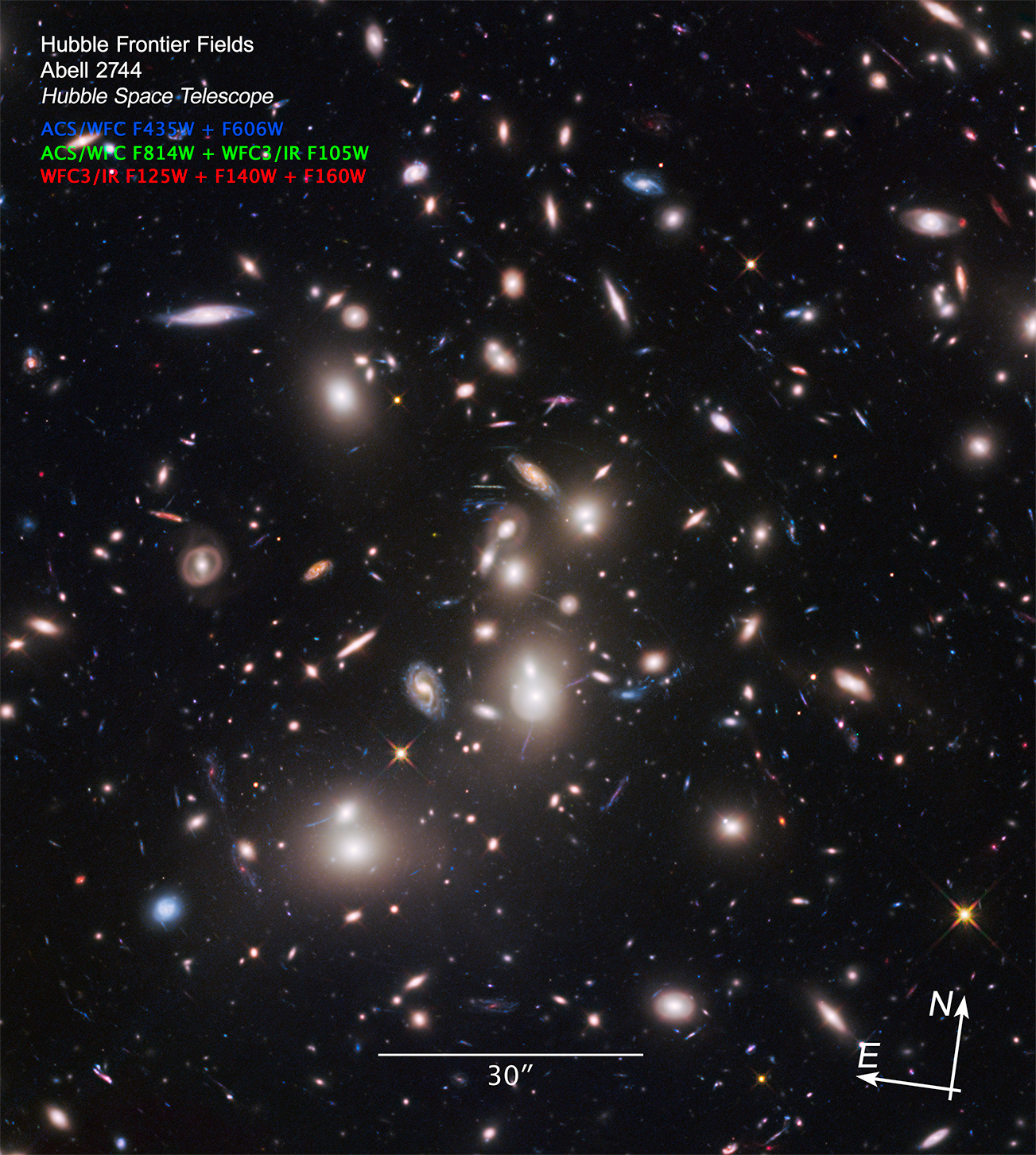
Here’s the result.  This is the galaxy cluster Abell 2744:

Final mosaic of the Frontier Fields galaxy cluster Abell 2744.  This image is the culmination of both epochs totaling 157 Hubble orbits. The numbers prefixed with "F" are the Hubble filters used by the ACS and WFC3 cameras to take the image.  The scale bar of 30" is approximately 2% the angular size of the full moon as seen from Earth - very small! Credit: NASA, ESA, and J. Lotz, M. Mountain, A. Koekemoer, and the HFF Team (STScI)

Final mosaic of the Frontier Fields galaxy cluster Abell 2744. This image is the culmination of both epochs totaling 157 Hubble orbits. The numbers prefixed with “F” are the Hubble filters used by the ACS and WFC3 cameras to take the image. The scale bar of 30″ is approximately 2% the angular size of the full moon as seen from Earth – very small!
Credit: NASA, ESA, and J. Lotz, M. Mountain, A. Koekemoer, and the HFF Team (STScI)

And here is the parallel field:

Parallel field of Frontier Field Abell 2744

This is the completed composite mosaic of the Parallel Fields observed with galaxy cluster Abell 2744.
Credit: NASA, ESA, and J. Lotz, M. Mountain, A. Koekemoer, and the HFF Team (STScI)

See? Epic! Er, I mean epoch.

Once the second epoch was completed, some of the faintest galaxies ever seen were measured for the first time.  Astronomers have been working on these images since their release, and we are anxiously awaiting to hear what they find.

What is Dark Energy?

There is a dark side to the universe; in fact, most of what makes up our cosmos is dark. In our post, entitled “What Is Dark Matter?” we introduced this pie chart that shows the relative composition of everything in the universe.

121236_NewPieCharts720

Composition of matter in the universe. These numbers have been revised by results from the Planck mission. More info here. Credit: NASA/ESA

This deceptively simple diagram shows the percentages of everything the universe is made of. Embedded in this uncomplicated, straightforward pie chart is a story full of surprises and anxiety.

Measuring the Universe

With the exception of Einstein’s “biggest blunder,” few prior to the 1990’s had any expectation that a cosmological force, such as dark energy, even existed. It was thought that the universe was solely comprised of normal matter and dark matter. There was much debate on the nature of dark matter.  How much is there? How much is made of exotic undiscovered particles versus the more mundane but visibly dark stuff like planets, small stars, etc.?  Much has been learned, but dark matter is still largely a mystery today.  Theories and experiments abound to find all constituents of the missing dark matter, particularly the exotic variety that does not contain normal matter, i.e., those particles that do not interact with normal matter other than via gravitational force.

Dark matter and normal matter both have one thing in common: gravity. Thus, the expectation for astronomers was that they would observe some decrease in the expansion rate of the universe over time due to the pull of gravity from all of the matter in the universe. In the 1990’s, two groups of astronomers attempted to measure the deceleration rate of the universe independently by looking at a whole bunch of Type 1a supernovae.  Type 1a supernovae are the explosions of a certain type of star, where the explosions themselves all have the same intrinsic brightness. You can determine how far away the star is by how bright it appears to us; the dimmer a Type 1a supernova appears, the farther away it must be.  Just like the equivalent of a standard 60–watt lightbulb, finding these “standard candles” allows astronomers to accurately measure the distances, and thus the time in the past, where these explosions took place.

Click here for more information on how Type 1a supernovae were used to measure distances.

What the astronomers actually discovered was far more surprising, and it was important that two different groups did this because, if only one had done it, no one would have believed what actually happened. These teams of astronomers noticed that distant supernovae, whose light from the early epochs of the universe was just now reaching our telescopes, were fainter and thus farther away than expected. In 1998, these two groups both declared that the universe wasn’t decelerating at all – it was accelerating!

This was a completely unexpected result — no one saw it coming. I mean, the universe is full of normal matter and dark matter, all gravitationally pulling on each other as the universe expands. Shouldn’t that mean the universe is slowing down its expansion? One could hear hyperventilating cosmologists from across the globe.

After everyone started to calm down, astronomers began to ask, “OK, so what does it take to have an accelerating universe?”

The answer is, you need something else besides matter. Whatever that is, we call it dark energy.

But What Does Dark Energy Mean?

After the initial surprise of finding an accelerating universe wore off and people started thinking about it, astronomers did something they rarely do — they accepted the idea rather quickly. Usually, an unexpected result like this generates huge debates among scientists, and this did too. The thing is, the notion of a cosmological force like dark energy now solved a lot more problems than it created. In an uncharacteristically short period of time, people started warming to the idea of dark energy.

As a function of time, galaxies are moving away from us at a faster and faster rate, and that is what is meant by an accelerating universe. The discovery of dark energy has brought the ultimate fate of our universe back into question. Will dark energy continue to increase its dominance over gravity and cause our universe to rip apart — a potential fate known as the Big Rip? Or will the repulsive force of dark energy and the attractive force of gravity balance out so that the universe expands forever at a constant, non-accelerating rate? With the current understanding of dark energy, it seems improbable that gravity will reverse the expansion and collapse the universe back in on itself. However, the nature of dark energy is not well understood yet.


What’s Next for Dark Energy?

Right now, astronomers are making observations designed to constrain some of the many dark energy models that are out there.  The nature of this research is often done from the ground so that wide areas of the sky can be observed for a very long time. This kind of campaign is not well-suited to a high-demand telescope like the Hubble Space Telescope. The idea is to “constrain,” or better understand, the expansion rate of the universe, and measure the growth of large–scale structure (like galaxy clusters).

Past surveys like the Sloan Digital Sky Survey have made some progress, and current projects like the Dark Energy Survey (DES) has started its observing runs. DES will observe 5,000 square degrees of the night sky over 525 nights, making measurements that should help us whittle down some of the many dark–energy models presently being considered. Currently being built is the Large Synoptic Survey Telescope, an 8.4–meter ground-based telescope in Chile, which will image the entire sky every few nights at several wavelengths, and will no doubt play a large role in helping us understand dark energy.

Space-based telescopes do have an essential role to play in characterizing dark energy. For example, Hubble has played a key role in getting data on distant supernovae — hence the discovery of dark energy. It is the combination of ground-based large surveys with space-based pointed deep follow-ups that give us our breakthroughs. Future missions are being envisioned to build on the best of both ground-based surveys and space-based observations. The Wide-Field Infrared Survey Telescope (WFIRST) will use a Hubble-class, space-based telescope to survey a large portion of the sky in an effort to better constrain the nature of dark energy through the history of the universe.

Frontier Fields and Dark Energy

While the Frontier Fields were not designed to capture the large numbers of supernovae needed to explore dark energy through cosmic time, the observations of strong galaxy cluster lensing will be used in combination with cosmological measurements from other missions to help constrain the nature of dark energy.  Stay tuned for more!