It Takes a Team

There is no denying that the history we tell about science is full of achievements often credited to individual efforts.  The reality, of course, is that scientific achievements are not done alone or in intellectual vacuums.

Standing on the Shoulders of Giants

Astronomer Edwin Hubble, for example, built upon the ideas of other astronomers when he made his landmark discovery in 1923 that the faint spiral nebulae observed in the sky were actually other galaxies outside our Milky Way.  This surprising finding greatly expanded our understanding of the size of the universe.
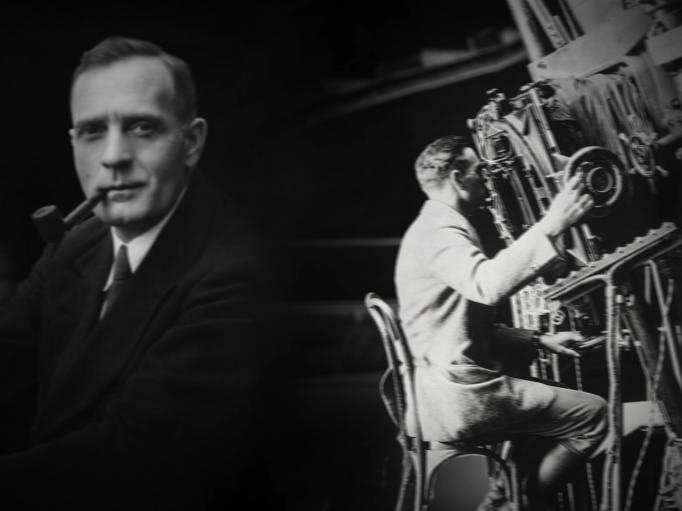
Still from Hubblecast episode 89: Edwin Hubble

This is a still image from Hubblecast 89, which talks about the life of Edwin Hubble.  Credit: NASA & ESA

Before Hubble’s discovery, scientists were embroiled in a fierce debate about the nature of these nebulae.  Some, most prominently astronomer Harlow Shapley, believed that these nebulae were parts of our own Milky Way galaxy.  Others, like Heber Curtis, posited that the Milky Way galaxy was smaller than suggested by Harlow Shapley, and these nebulae were likely entire galaxies outside of the Milky Way.  This scientific disagreement was brought to the fore during a public debate between Curtis and Shapley in 1920.

It was not until 1923 when Edwin Hubble observed a cepheid variable star in one such nebulae that the debate was quickly settled.  Hubble determined that the cepheid variable he was observing was very far away – much too far away to be a part of the Milky Way galaxy.  In fact, he had discovered the variable star resided in what we now know to be our neighboring Andromeda galaxy.  This put to rest the debate vociferously argued by Shapley and Curtis.

Cepheid variable stars are stars whose intrinsic brightnesses change with time by a known amount. This makes them great “standard candles” to calculate their distances.  If you know you are observing a 60-watt light bulb, you can calculate the distance to the light bulb based on the amount of light you observe – the  fainter the 60-watt light bulb appears, the farther away it is.

The key to Hubble’s discovery was the knowledge that we could determine a cepheid variable’s intrinsic brightness based off of its observed periodicity, which is the amount of time the variable star takes to go from maximum brightness to minimum brightness and back to maximum brightness.  Hubble could not make his discovery without this background information, which, as it turns out, was first published in 1912 by astronomer Henrietta Swan Leavitt.  Henrietta was not given proper credit for this monumental discovery at the time, but there is now no doubt that her efforts paved the way for our modern understanding of stars and distances in the cosmos.
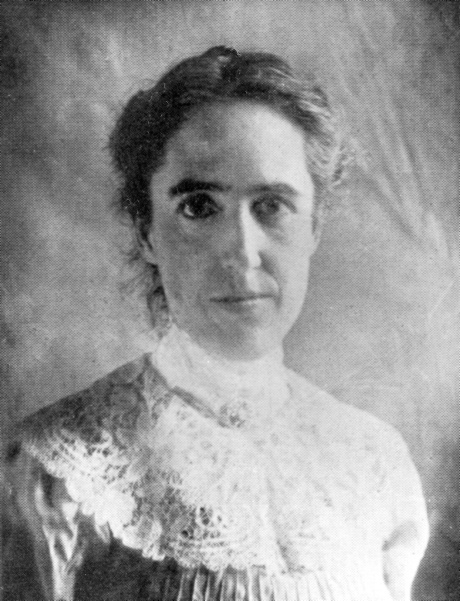
leavitt_aavso

Picture of astronomer Henrietta Swan Leavitt taken before 1921.

Astronomy, like all sciences, is dependent on building upon our scaffolded knowledge to further our understanding into new realms of the unknown.  It also depends upon teams of dedicated individuals working together.  Edwin Hubble, a premiere astronomer of the early 20th century, built upon the discoveries of prior scientists and engineers.  He also depended upon the support of his assistant and the staff of the Mt. Wilson Observatory, where he conducted many of his observations.

The Frontier Fields: A Team of Professionals Building Upon the Successes of Prior Programs

Today, astronomy is increasingly relying on larger projects that require teams of men and women with diverse skill sets, including the Hubble Frontier Fields program.  Frontier Fields was conceived following the successes of prior Hubble deep-field programs.  These include the Hubble Deep Field, Hubble Ultra Deep Field, CANDELS, and in particular, CLASH – which helped build our understanding of gravitational lensing around galaxy clusters.  The general Frontier Fields program also both benefited from, and enhanced, our understanding of mathematical models that predict how light from distant galaxies will be lensed by foreground massive clusters.  Of course, all of the deep-field studies are possible because of the work of prior luminaries such as Edwin Hubble, Henrietta Leavitt, and Albert Einstein.

In July 2016, the Hubble Frontier Fields team was given the AURA team award.  AURA – the Association of Universities for Research in Astronomy – operates the Space Telescope Science Institute (STScI – the science operations center for Hubble) for NASA.

"The STScI Frontier Fields team receives the 2016 AURA team award for its
unparalleled efforts in implementing the Hubble Frontier Fields Director's
Discretionary program and providing rapid [astronomical] community access to
high-level data products generated from the observations." - AURA

The full list of recipients of the AURA award can be found by clicking the link below.

hubble-frontier-fields-aura-award-recipients
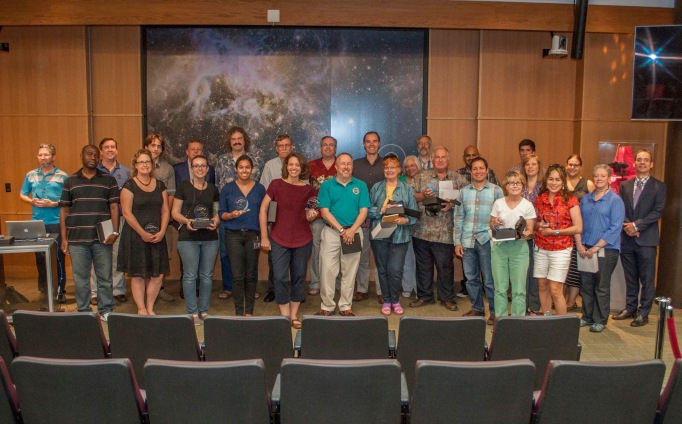
2016 AURA Team  Award - STScI Frontier Fields

Some of the recipients of the 2016 AURA team award.  The team received the award in July 2016 for the Hubble Frontier Fields program, which began in 2013.  Credit: P. Jeffries/STScI.

In addition to the awardees, there is also support from the STScI directorate (Ken Sembach and Neill Reid).

It should be noted that the NASA Frontier Fields program is bigger than just the core Hubble Frontier Fields program at STScI.  There are also teams of people working with NASA’s other Great Observatories, the Chandra X-ray Observatory and the Spitzer Space Telescope, to acquire images of these fields in invisible X-ray and infrared light.  There are teams of astronomers proposing for follow-up observations of the Frontier Fields using many ground-based observatories in radio, millimeter, infrared, and visible light.  In addition, there are the astronomers and mathematical modelers who are taking this publicly available data and using it to broaden our understanding of the physics of the cosmos.

Science truly is a team sport.
Beyond the Frontier Fields: How JWST Will Push the Science to a New Frontier

The Frontier Fields Project has been an ambitious campaign to see deep into our universe. Gravitational lensing, as used by the Frontier Fields Project, enables Hubble to see fainter and more-distant galaxies than would otherwise be possible. These images push to the very limits of how deeply Hubble can see out into space.

Hubble, Spitzer, Chandra, and other observatories are doing cutting-edge science through the Frontier Fields Project, but there’s a challenge. Even though leveraging gravitational lensing has allowed astronomers to see objects that otherwise could not be detected with today’s telescopes, the technique still isn’t enough to see the most distant galaxies. As the universe expands, light gets stretched into longer and longer wavelengths, beyond the visible and near-infrared wavelengths Hubble can detect. To see the most distant galaxies, one needs a space telescope with Hubble’s keen resolution, but at infrared wavelengths.

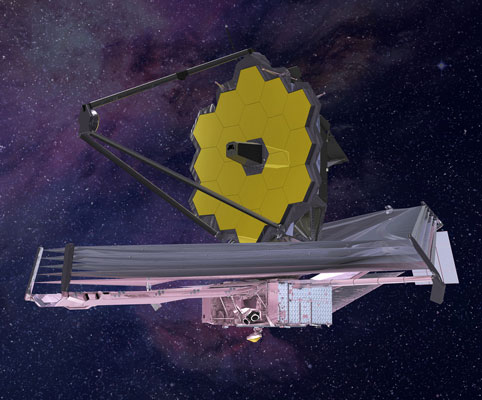
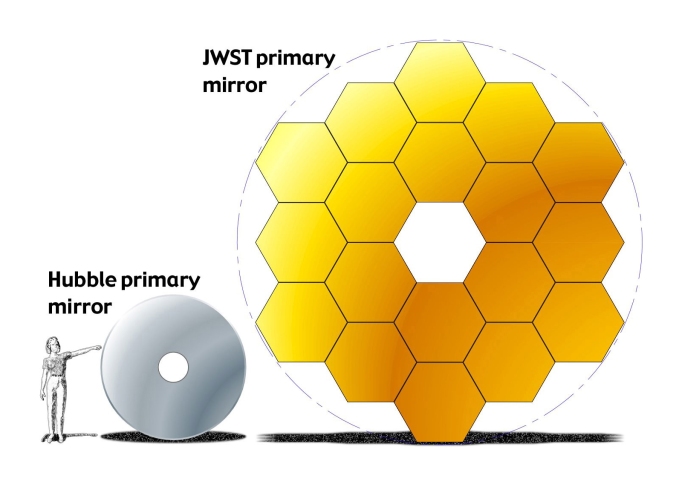
That infrared telescope is the James Webb Space Telescope, slated to launch in October 2018. It has a mirror 6.5 meters (21 feet) across, can observe wavelengths up to 10 times longer than Hubble can observe, and is the mission that will detect and study the first appearances of galaxies in the universe.full_jwst_hst_mirror_comparison

Figure 1: Webb will have a 6.5-meter-diameter primary mirror, which would give it a significant larger collecting area than the mirrors available on the current generation of space telescopes. Hubble’s mirror is a much smaller 2.4 meters in diameter, and its corresponding collecting area is 4.5 square meters, giving Webb around seven times more collecting area! Webb’s field of view is more than 15 times larger than the NICMOS near-infrared camera on Hubble. It also will have significantly better spatial resolution than is available with the infrared Spitzer Space Telescope. Credit: NASA. http://webbtelescope.org/gallery

Observations of the early universe are still incomplete. To build the full cosmological history of our universe, we need to see how the first stars and galaxies formed, and how those galaxies evolved into the grand structures we see today.


Looking back in time to the first light in the universe:

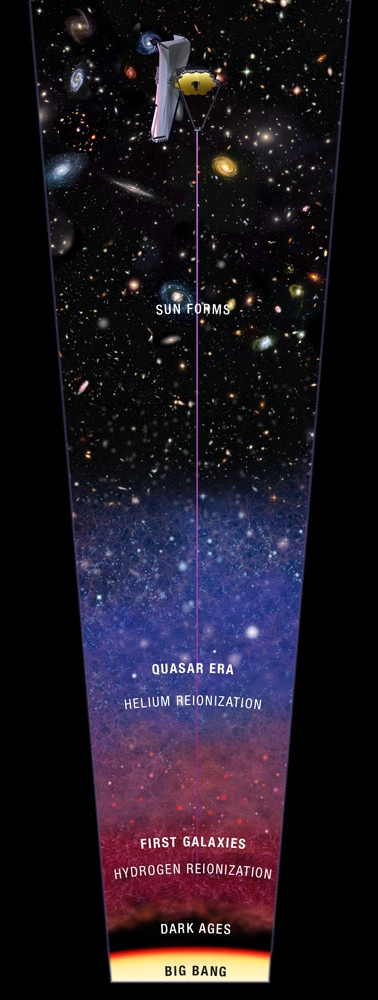
Astronomers use light to explore the universe, but there are pieces of our universe’s early history where there wasn’t much light. The era of the universe called the “Dark Ages” is as mysterious as its name implies. Shortly after the Big Bang, our universe was filled with glowing plasma, or ionized gas. As the universe cooled and expanded, electrons and protons began to bind together to form neutral hydrogen atoms (one proton and one electron each). The last of the light from the Big Bang escaped (becoming what we now detect as the Cosmic Microwave Background). The universe would have been a dark place, with no sources of light to reveal this cooling, neutral hydrogen gas.

Some of that gas would have begun coalescing into dense clumps, pulled together by gravity. As these clumps grew larger, they would become stars and eventually galaxies. Slowly, starlight would begin to shine in the universe. Eventually, as the early stars grew in numbers and brightness, they would have emitted enough ultraviolet light to “reionize” the universe by stripping electrons off neutral hydrogen atoms, leaving behind individual protons. This process created a hot plasma of free electrons and protons. At this point, the light from star and galaxy formation could travel freely across space and illuminate the universe. It is important to note here, astronomers are currently unsure whether the energy responsible for reionization came from stars in the early-forming galaxies; rather, it might have come from hot gas surrounding massive black holes or some even more exotic source such as decaying dark matter.

The universe’s first stars, believed to be 30 to 300 times as massive as our Sun and millions of times as bright, would have burned for only a few million years before dying in tremendous explosions, or “supernovae.” These explosions spewed the recently manufactured chemical elements of stars outward into the universe before the expiring stars collapsed into black holes.

Astronomers know the universe became reionized because when they look back at quasars — incredibly bright objects thought to be powered by supermassive black holes — in the distant universe, they don’t see the dimming of their light that would occur if the light passed through a fog of neutral hydrogen gas. While they find clouds of neutral hydrogen gas, they see almost no signs of neutral hydrogen gas in the matter located in the space between galaxies. This means that at some point the matter was reionized. Exactly when this occurred is one of the questions Webb will help answer, by looking for glimpses of very distant objects still dimmed by neutral hydrogen gas.

Much remains to be uncovered about the time of reionization. The universe right after the Big Bang would have consisted of hydrogen, helium, and a small amount of lithium. But the stars we see today also contain heavier elements — elements that are created inside stars. So how did those first stars form from such limited ingredients? Webb may not be able to see the very first stars of the Dark Ages, but it’ll witness the generation of stars immediately following, and analyze the kinds of materials they contain.

Webb’s ability to see the infrared light from the most distant objects in the universe will allow it to truly identify the sources that gave rise to reionization. For the first time, we will be able to see the stars and quasars that unleashed enough energy to illuminate the universe again.

9682953582_7029d9580d_b

Figure 2: JWST will be able to see back to when the first bright objects (stars and galaxies) were forming in the early universe. Credit: STScI. http://jwst.nasa.gov/firstlight.html


Early Galaxies:

Webb will also show us how early galaxies formed from those first clumps of stars. Scientists suspect the black holes born from the explosions of the earliest stars (supernovae) devoured gas and stars around them, becoming the extremely bright objects called “mini-quasars.” The mini-quasars, in turn, may have grown and merged to become the huge black holes found in the centers of present-day galaxies. Webb will try to find and understand these supernovae and mini-quasars to put theories of early galaxy formation to the test. Do all early galaxies have these mini-quasars or only some? These regions give off infrared light as the gas around them cools, allowing Webb to glean information about how mini-quasars in the early universe work — how hot they are, for instance, and how dense.

Webb will show us whether the first galaxies formed along lines and webs of dark matter, as expected, and when. Right now we know the first galaxies formed anywhere from 378,000 years to 1 billion years after the Big Bang. Many models have been created to explain which era gave rise to galaxies, but Webb will pinpoint the precise time period.

Hubble is known for its deep-field images, which capture slices of the universe throughout time. But these images stop at the point beyond which Hubble’s vision cannot reach. Webb will fill in the gaps in these images, extending them back to the Dark Ages. Working together, Hubble and Webb will help us visualize much more of the universe than we ever have before, creating for us an unprecedented picture that stretches from the current day to the beginning of the recognizable universe.

th-webb-telescope-artist-view5_2x__1_

Figure 3: This illustration shows the cold side of the Webb telescope, where the mirrors and instruments are positioned. Credit: Northrop Grumman. http://webbtelescope.org/gallery


Resources:

https://frontierfields.org/2016/07/21/the-final-frontier-of-the-universe/

http://hubble25th.org/science/8

http://webbtelescope.org/article/13