Galaxy Find Showcases Frontier Fields’ Potential

A faraway object in Frontier Fields cluster Abell 2744 could be one of the most distant galaxies found to date, according to an international team studying a combination of Hubble and Spitzer data on the cluster.

The galaxy, called Abell2744_Y1, is about 30 times smaller than our Milky Way galaxy but is producing at least 8 times more stars. Further observations are needed to verify the galaxy’s redshift, which will help determine how truly distant it is. The highest-redshift galaxies, with values greater than 8 or 9, are so distant we see them as they were about 13 billion years ago. For comparison, galaxies with a redshift around 0 are in our local neighborhood and galaxies with a redshift of around 1 appear as they were halfway back to the Big Bang. Astronomers are hoping Abell2744_Y1 is in the high-redshift range.
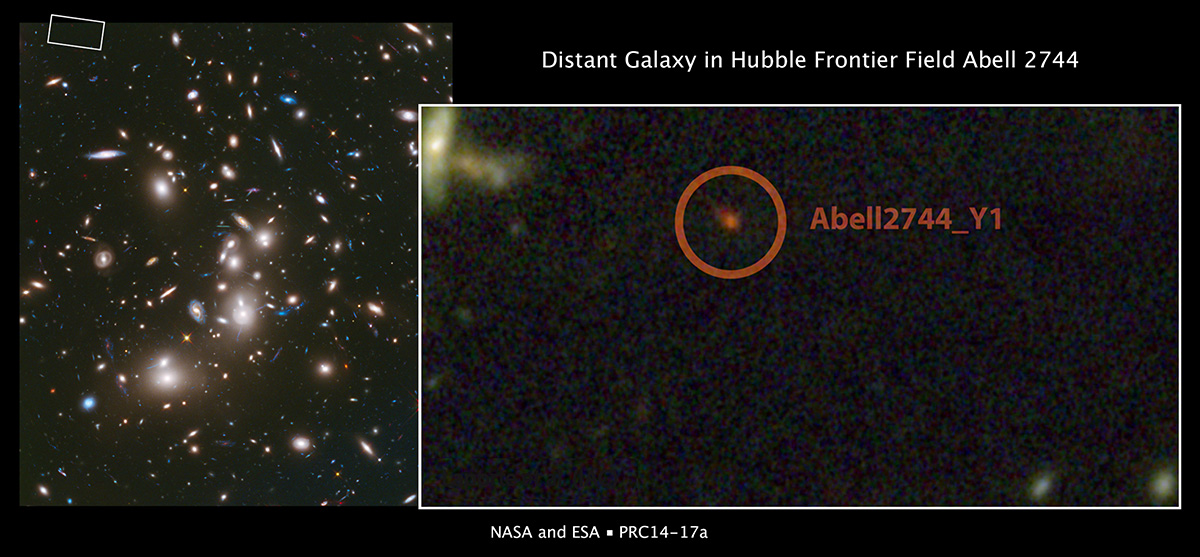
hs-2014-17-a-web_printAbell2744_Y1 (right) and its location in the Abell 2744 galaxy cluster (left). Credit: NASA, ESA, and J. Lotz, M. Mountain, A. Koekemoer, and the HFF Team (STScI), and N. Laporte (Instituto de Astrofisica de Canarias)

Though scientists are interested in galaxies with redshifts in the lower range, technological advances have made those discoveries far more routine. For many astronomers, the focus today is on galaxies with the higher redshifts. The difference is significant, since lower-redshift galaxies appear in our observations as they were billions of years after the Big Bang, but higher-redshift galaxies can show us the state of the universe just hundreds of millions of years after the Big Bang.

Astronomers can find these high-redshift objects with modern telescopes, but the ones they see tend to be the biggest, brightest galaxies of the early universe — the unusual objects, the outliers. To see the more normal objects — the typical galaxies of the time — astronomers use natural gravitational lenses in space to extend the reach of telescopes. And that’s where Frontier Fields comes in.

The Frontier Fields project will be looking at galaxy cluster Abell 2744 again in May, and using its natural lens to find more galaxies like Abell2744_Y1. The more ordinary, representative galaxies astronomers encounter, the better they can understand and explain the development of the early universe. Just as you couldn’t draw an accurate portrait of humanity by only examining the tallest people on the planet, scientists can’t build a complete picture of the universe when they can only detect its biggest and brightest galaxies. Astronomers need a large sample of everyday galaxies to learn what that population is really like.

Since 2006, the number of high-redshift galaxies known has increased from a dozen to 236, but only two have been confirmed as actually being high-redshift galaxies. To truly confirm the objects’ distances, astronomers need to obtain spectra of the galaxies. When Hubble looks at Abell 2744, it won’t be taking spectra of Abell2744_Y1, but the galaxy is bright enough to be detected by major ground-based telescopes, so it’s possible an Earth-based observatory may confirm its distance.

The small galaxy is producing stars at a rate of anywhere from eight to 60 solar masses per year, much more than the Milky Way’s star production rate of about one to three solar masses per year. A solar mass is the equivalent of our Sun’s mass. That number may not sound like much, but remember that stars develop over the course of millions of years, meaning that tiny galaxy is pumping out stars at a thoroughly respectable pace. Will other distant galaxies magnified by Abell 2744’s gravitational lens match its production? We’ll learn more as the Frontier Fields data begins to pour in.
Meet the Frontier Fields: MACS J1149.5+2223

This is the fourth in a series of posts introducing and providing essential facts about each of the Frontier Fields.

The gravitational lens created by the galaxy cluster MACS J1149 already has a record of stirring up excitement. In 2012, observations from NASA’s Hubble and Spitzer space telescopes found the cluster had magnified a distant background galaxy. The galaxy turned out to be extremely far away — in fact, the light we detected from the galaxy likely began its intergalactic journey approximately 500 million years after the Big Bang1. This galaxy appears to us as it looked when the universe was just 3.6 percent of its present age of 13.7 billion years — a baby picture of a (very) distant relative. Astronomers estimate that the gravitational lens of MACS J1149 magnified the brightness of this distant galaxy by 15 times; it would have remained undetected were it not for the help from one of nature’s powerful lenses. This discovery bodes well for the deeper images of galaxy clusters being undertaken in the Frontier Fields program.

The Massive Cluster Survey (MACS) contains a sample of more than 100 galaxy clusters, measured by the ROSAT telescope to be bright in high-energy X-ray light. The goal of the MACS survey is to understand distant, massive galaxy clusters.

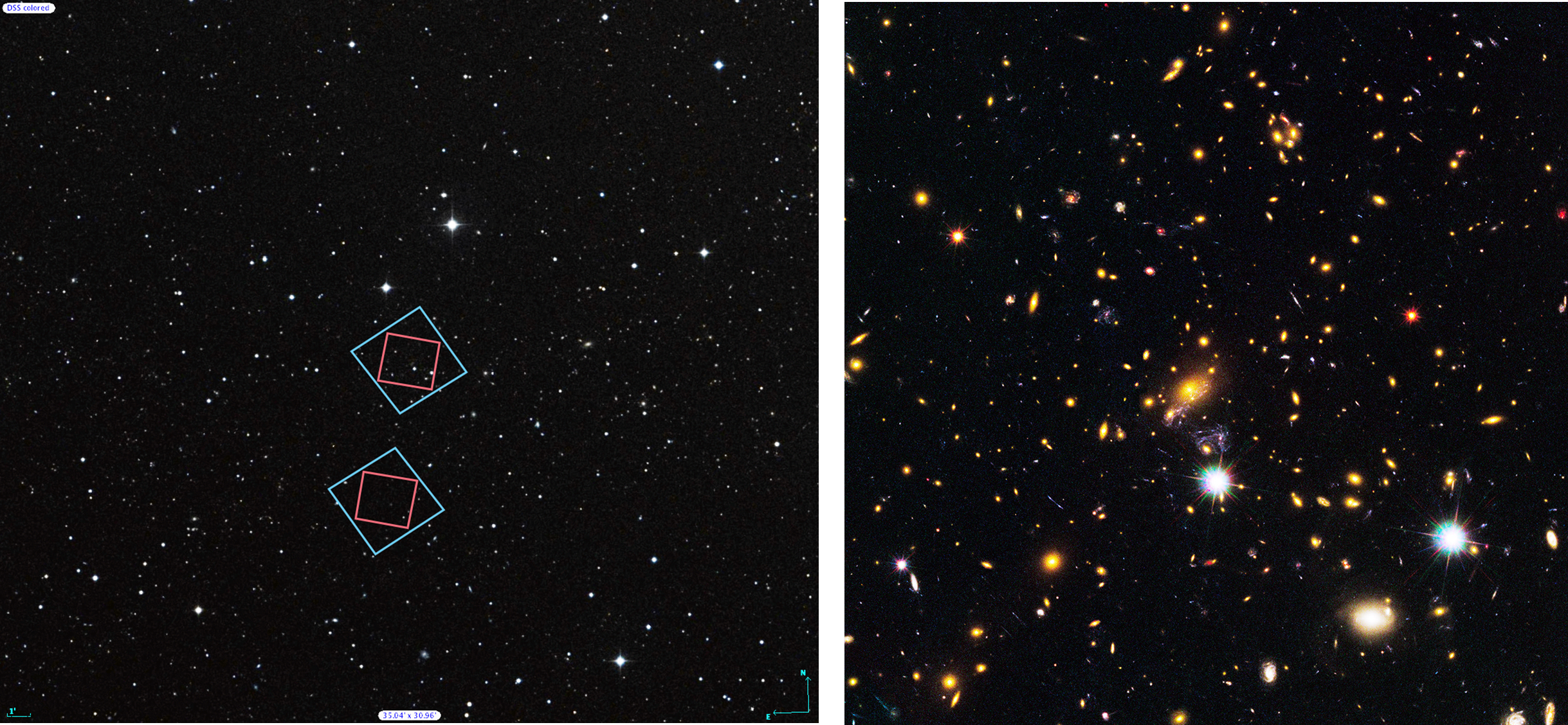
(Left) Locations of Hubble’s observations of the MACS  J1149 galaxy cluster, top, and the nearby parallel field, bottom, plotted over a Digital Sky Survey (DSS) image. The blue boxes outline the regions of Hubble’s visible light observations, and the red boxes indicate areas of Hubble’s infrared light observations. The 1’ bar, read as one arcminute, corresponds to approximately 1/30 the apparent width of the full moon as seen from Earth. (Right) Archival Hubble image of the MACS J1149 galaxy cluster taken in visible light. Left Credit: Digitized Sky Survey (STScI/NASA) and Z. Levay (STScI). Right Credit: NASA, ESA, and M. Postman (STScI), and the CLASH team.

Left: The locations of Hubble’s observations of the MACS J1149 galaxy cluster (top) and the adjacent parallel field (bottom) are plotted over a Digitized Sky Survey (DSS) image. The blue boxes outline the regions of Hubble’s visible-light observations, and the red boxes indicate areas of Hubble’s infrared-light observations. A scale bar in the lower left corner of the image indicates the size of the image on the sky. The scale bar corresponds to approximately 1/30th the apparent width of the full moon as seen from Earth. Astronomers refer to this unit of measurement as one arcminute, denoted as 1′.
Right: Hubble’s view of the galaxy cluster is displayed using archival visible-light observations. Deeper Frontier Fields observations of MACS J1149 are planned for 2014 and 2015.
Left Credit: Digitized Sky Survey (STScI/NASA) and Z. Levay (STScI).
Right Credit: NASA, ESA, and M. Postman (STScI), and the CLASH team.

Estimated Dates of Observations: April-June 2014, November 2014-February 2015, and April-July 2015

The planned dates for Hubble observations of the Frontier Fields include observations approximately six months apart. This is the time it takes for the cameras on Hubble to swap positions so that both visible-light data and infrared-light data can be captured from the galaxy cluster field and the adjacent parallel field, as described in this post.

Galaxy Cluster Redshift: 0.543

Redshift measures the lengthening of a light wave from an object that is moving away from an observer. For example, when a galaxy is traveling away from Earth, its observed wavelength shifts toward the red end of the electromagnetic spectrum. The galaxy cluster’s cosmological redshift refers to a lengthening of a light wave caused by the expansion of the universe. Light waves emitted by a galaxy cluster stretch as they travel through the expanding universe. The greater the redshift, the farther the light has traveled to reach us.

Galaxy Cluster Distance: approximately 5 billion light-years

Galaxy Cluster Field Coordinates (R.A., Dec.): 11:49:36.3, +22:23:58.1

Parallel Field Coordinates (R.A., Dec.): 11:49:40.5, +22:18:02.3

Constellation: Leo

Related Hubble News:

Looking for Hubble data used by scientists?

References to science journal articles:

1: A highly magnified candidate for a young galaxy seen when the Universe was 500 Myrs old

Meet the Frontier Fields: MACS J0717.5+3745

This is the third in a series of posts introducing and providing essential facts about each of the Frontier Fields.

MACS J0717 has been observed by telescopes in many visible and invisible wavelengths of light. It is one of the most massive galaxy clusters known, and it is the largest known gravitational lens1. Of all of the galaxy clusters known and measured, MACS J0717 lenses the largest area of the sky.

The Massive Cluster Survey (MACS) contains a sample of more than 100 galaxy clusters, measured by the ROSAT telescope to be bright in high-energy X-ray light. The goals of the MACS survey are to categorize and better understand distant massive galaxy clusters. J0717 has the highest X-ray temperature in the MACS survey.

(Left) Locations of Hubble’s observations of the MACS J0717 galaxy cluster, bottom, and the nearby parallel field, top, plotted over a Digital Sky Survey (DSS) image. The blue boxes outline the regions of Hubble’s visible light observations, and the red boxes indicate areas of Hubble’s infrared light observations. The 1’ bar, read as one arcminute, corresponds to approximately 1/30 the apparent width of the full moon as seen from Earth. (Right) Archival Hubble image of the MACS J0717 galaxy cluster taken in visible light. Left Credit: Digitized Sky Survey (STScI/NASA) and Z. Levay (STScI). Right Credit: NASA, ESA, and H. Ebeling (University of Hawaii).

Left: The locations of Hubble’s observations of the MACS J0717 galaxy cluster (bottom) and the adjacent parallel field (top) are plotted over a Digitized Sky Survey (DSS) image. The blue boxes outline the regions of Hubble’s visible-light observations, and the red boxes indicate areas of Hubble’s infrared-light observations. A scale bar in the lower left corner of the image indicates the size of the image on the sky. The scale bar corresponds to approximately 1/30th the apparent width of the full moon as seen from Earth. Astronomers refer to this unit of measurement as one arcminute, denoted as 1′.
Right: Hubble’s view of the galaxy cluster is displayed using archival visible-light observations. Deeper Frontier Fields observations of MACS J0717 are planned for 2014 and 2015.
Left Credit: Digitized Sky Survey (STScI/NASA) and Z. Levay (STScI).
Right Credit: NASA, ESA, and H. Ebeling (University of Hawaii).

Estimated Dates of Observations: September-November 2014 and February-May 2015

The planned dates for Hubble observations of the Frontier Fields include observations approximately six months apart. This is the time it takes for the cameras on Hubble to swap positions so that both visible-light data and infrared-light data can be captured from the galaxy cluster field and the adjacent parallel field, as described in this post.

Galaxy Cluster Redshift: 0.545

Redshift measures the lengthening of a light wave from an object that is moving away from an observer. For example, when a galaxy is traveling away from Earth, its observed wavelength shifts toward the red end of the electromagnetic spectrum. The galaxy cluster’s cosmological redshift refers to a lengthening of a light wave caused by the expansion of the universe. Light waves emitted by a galaxy cluster stretch as they travel through the expanding universe. The greater the redshift, the farther the light has traveled to reach us.

Galaxy Cluster Distance: approximately 5 billion light-years

Galaxy Cluster Field Coordinates (R.A., Dec.): 07:17:34.0, +37:44:49.0

Parallel Field Coordinates (R.A., Dec.): 07:17:17.0, +37:49:47.3

Constellation: Auriga

Related Hubble News:

Looking for Hubble data used by scientists?

References to science journal articles:

1: CLASH: Complete Lensing Analysis of the Largest Cosmic Lens MACS J0717.5+3745 and Surrounding Structures

Meet the Frontier Fields: MACS J0416.1-2403

This is the second in a series of posts introducing and providing essential facts about each of the Frontier Fields.

Einstein’s theory of general relativity tells us how the curvature of space causes the path of light from a more distant galaxy to bend as the light passes near a massive cluster of galaxies. The cluster of galaxies acts as a lens, magnifying and distorting the light from the more distant galaxy. This often leads to astronomers observing multiple “lensed images” of the distant galaxy. Compared to other commonly observed galaxy clusters, MACS J0416 is more efficient at producing multiple lensed images of background galaxies1. This means that we expect to find a higher than usual number of images for every galaxy lensed by MACS J0416.

The Massive Cluster Survey (MACS) contains a sample of more than 100 galaxy clusters, measured by the ROSAT telescope to be bright in high-energy X-ray light. The goals of the MACS survey are to categorize and better understand distant massive galaxy clusters.

(Left) Locations of Hubble’s observations of the MACS J0416 galaxy cluster, right, and the nearby parallel field, left, plotted over a Digital Sky Survey (DSS) image. The blue boxes outline the regions of Hubble’s visible light observations, and the red boxes indicate areas of Hubble’s infrared light observations. The 1’ bar, read as one arcminute, corresponds to approximately 1/30 the apparent width of the full moon as seen from Earth. (Right) Archival Hubble image of the MACS J0416 galaxy cluster taken in visible light. Left Credit: Digitized Sky Survey (STScI/NASA) and Z. Levay (STScI). Right Credit: NASA, ESA, and M. Postman (STScI), and the CLASH team.

Left: The locations of Hubble’s observations of the MACS J0416 galaxy cluster (right) and the adjacent parallel field (left) are plotted over a Digitized Sky Survey (DSS) image. The blue boxes outline the regions of Hubble’s visible-light observations, and the red boxes indicate areas of Hubble’s infrared-light observations. A scale bar in the lower left corner of the image indicates the size of the image on the sky. The scale bar corresponds to approximately 1/30th the apparent width of the full moon as seen from Earth. Astronomers refer to this unit of measurement as one arcminute, denoted as 1′.
Right: Hubble’s view of the galaxy cluster is displayed using archival visible-light observations. Deeper Frontier Fields observations of MACS J0416 are ongoing.
Left Credit: Digitized Sky Survey (STScI/NASA), and Z. Levay (STScI).
Right Credit: NASA, ESA, M. Postman (STScI), and the CLASH team.

Estimated Dates of Observations: January-February 2014 and August-September 2014

The planned dates for Hubble observations of the Frontier Fields include observations approximately six months apart. This is the time it takes for the cameras on Hubble to swap positions so that both visible-light data and infrared-light data can be captured from the galaxy cluster field and the adjacent parallel field, as described in this post.

Galaxy Cluster Redshift: 0.396

Redshift measures the lengthening of a light wave from an object that is moving away from an observer. For example, when a galaxy is traveling away from Earth, its observed wavelength shifts toward the red end of the electromagnetic spectrum. The galaxy cluster’s cosmological redshift refers to a lengthening of a light wave caused by the expansion of the universe. Light waves emitted by a galaxy cluster stretch as they travel through the expanding universe. The greater the redshift, the farther the light has traveled to reach us.

Galaxy Cluster Distance: approximately 4 billion light-years

Galaxy Cluster Field Coordinates (R.A., Dec.): 04:16:08.9, -24:04:28.7

Parallel Field Coordinates (R.A., Dec.): 04:16:33.1, -24:06:48.7

Constellation: Eridanus

Related Hubble News:

Looking for Hubble data used by scientists?

References to science journal articles:

1: CLASH: The enhanced lensing efficiency of the highly elongated merging cluster MACS J0416.1-2403

Frontier Fields at AAS 224

Frontier Fields had a big presence at this year’s January meeting of the American Astronomical Society.  On Jan. 7, there was a news release announcing the results of the first set of observations of galaxy cluster Abell 2744, along with a gorgeous image of the cluster.  We met with Dr. Jennifer Lotz, the principal investigator for Frontier Fields to get an update and discuss these latest results.

Meet the Frontier Fields: Abell 2744

This is the first in a series of posts introducing and providing essential facts about each of the Frontier Fields.

Abell 2744, also known as Pandora’s Cluster, is a giant pile-up of four smaller galaxy clusters. Abell 2744, and its neighboring parallel field, are among the first targets of the Frontier Fields program.

The Abell catalogue of galaxy clusters was first compiled by astronomer George O. Abell in 1958, with over 2,700 galaxy clusters observable from the Northern Hemisphere. The Abell catalogue was updated in 1989 with galaxy clusters from the Southern Hemisphere.

Locations of Hubble's observations of the Abell 2744 galaxy cluster (left) and the nearby parallel field (right), plotted over a Digital Sky Survey (DSS) image. The blue boxes outline the regions of Hubble's visible light observations, and the red boxes indicate areas of Hubble's infrared light observations. The 1’ bar, read as one arcminute, corresponds to approximately 1/30 the apparent width of the full moon as seen from Earth. Credit: Digitized Sky Survey (STScI/NASA) and Z. Levay (STScI).

The locations of Hubble’s observations of the Abell 2744 galaxy cluster (left) and the adjacent parallel field (right) are plotted over a Digitized Sky Survey (DSS) image. The blue boxes outline the regions of Hubble’s visible-light observations, and the red boxes indicate areas of Hubble’s infrared-light observations. A scale bar in the lower left corner of the image indicates the size of the image on the sky. The scale bar corresponds to approximately 1/30th the apparent width of the full moon as seen from Earth. Astronomers refer to this unit of measurement as one arcminute, denoted as 1′.
Credit: Digitized Sky Survey (STScI/NASA) and Z. Levay (STScI).

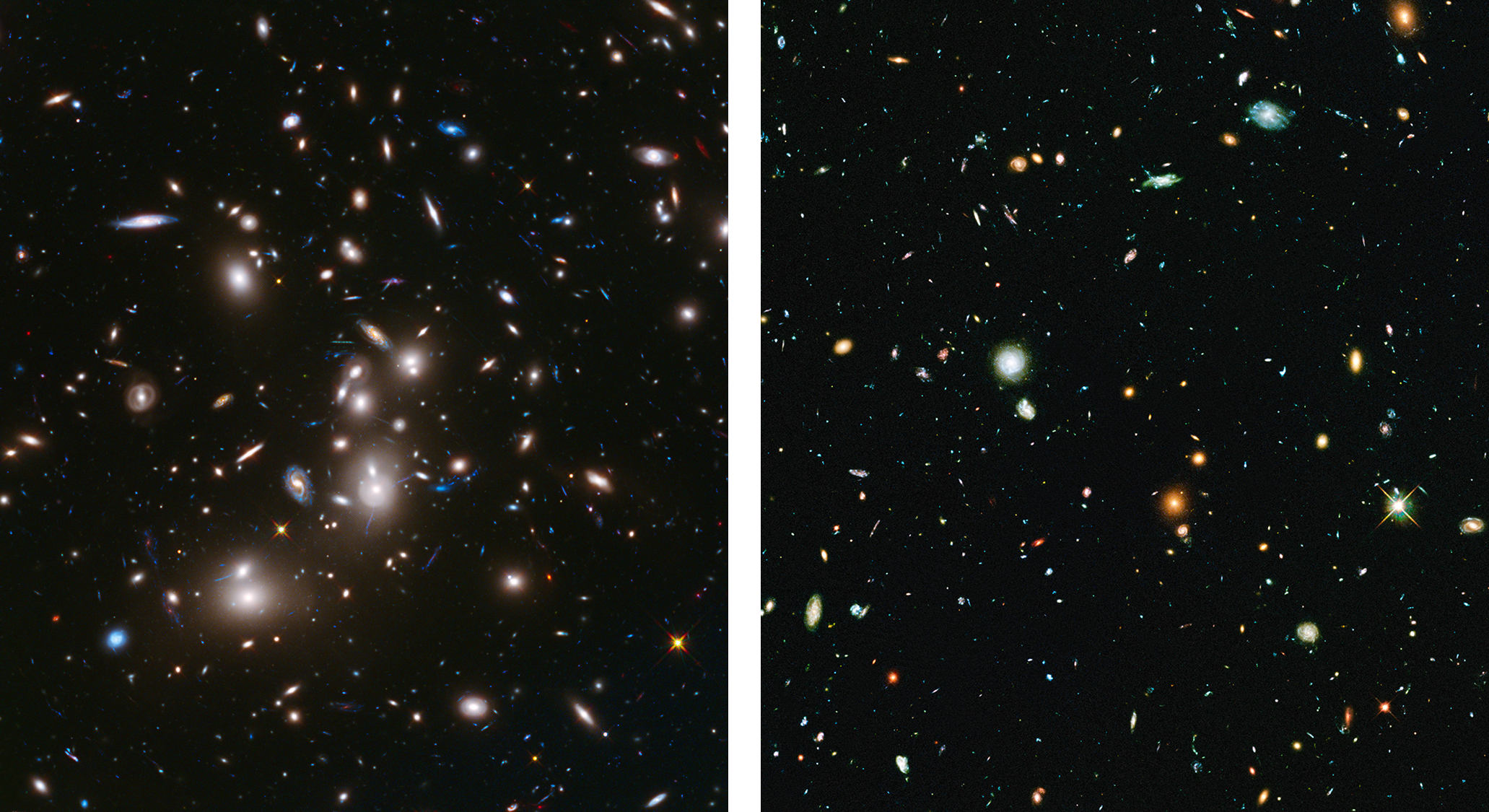
Early Frontier Field image of Abell 2744 with ~ 1/2 of the expected data included. (Left) Frontier Fields data of the galaxy cluster Abell 2744. Newly obtained infrared light data is shown in red. Visible light is included from archived observations, shown in blue and green. (Right) New Frontier Fields visible light data of the parallel field. Credit: NASA, ESA, and J. Lotz, M. Mountain, A. Koekemoer, and the HFF Team (STScI)

Shown here, with approximately half of the expected data included, are the early Frontier Fields images of Abell 2744 and the associated parallel field. Left: Frontier Fields image of the galaxy cluster Abell 2744 is displayed with colors chosen to highlight the newly obtained infrared data. The infrared-light data are shown in red. Visible-light data are included from archived observations and displayed in blue and green. Right: The new Frontier Fields image of the adjacent parallel field is displayed. In this image, all of the colors represent visible-light data.
Credit: NASA, ESA, and J. Lotz, M. Mountain, A. Koekemoer, and the HFF Team (STScI)

Estimated Dates of Observations: October-November 2013 and May-June 2014

The planned dates for Hubble observations of the Frontier Fields include observations approximately six months apart. This is the time it takes for the cameras on Hubble to swap positions so that both visible-light data and infrared-light data can be captured from the galaxy cluster field and the adjacent parallel field, as described in this post.

Galaxy Cluster Cosmological Redshift: 0.308

Redshift measures the lengthening of a light wave from an object that is moving away from an observer. For example, when a galaxy is traveling away from Earth, its observed wavelength shifts toward the red end of the electromagnetic spectrum. The galaxy cluster’s cosmological redshift refers to a lengthening of a light wave caused by the expansion of the universe.  Light waves emitted by a galaxy cluster stretch as they travel through the expanding universe. The greater the redshift, the farther the light has traveled to reach us.

Galaxy Cluster Distance: approximately 3.5 billion light-years

Galaxy Cluster Field Coordinates (R.A., Dec.): 00:14:21.2, -30:23:50.1

Parallel Field Coordinates (R.A., Dec.): 00:13:53.6, -30:22:54.3

Constellation: Sculptor

Related Hubble News:

Looking for Hubble data used by scientists?