What’s Really in a Frontier Fields Image?

What are we actually seeing when we look at one of the Frontier Fields images? The gravitational lensing that produces the strange, almost artistic-looking effects in the images — the streaks and blobs of light among glowing galaxies – is visually striking, but little of it falls into typical expectations of what we see when we look into the universe.

Archival image of the Abell 2744 cluster taken with Hubble's visible light ACS instrument. Credit: NASA, ESA, and R. Dupke (Eureka Scientific, Inc.), et al.

Archival image of the Abell 2744 cluster taken with Hubble’s visible light ACS instrument.
Credit: NASA, ESA, and R. Dupke (Eureka Scientific, Inc.), et al.

Let’s break it down by examining this image of galaxy cluster Abell 2744, also known as Pandora’s Cluster. Four separate galaxy clusters containing several hundred galaxies are colliding in this image, providing the vast amount of mass — both normal and, most importantly, dark matter — needed to create a gravitational lens. The galaxies’ mass warps space and brightens, distorts and magnifies the light of nearly 3,000 galaxies located much farther away, behind the cluster.

For simplicity’s sake we’ve highlighted a representative sample of objects in the image. The highlighting therefore doesn’t capture every single object — just a handful of good examples.

Stars

In this image, the white circles enclose stars in our own Milky Way galaxy. The stars have a distinctive cross-shape created by light reflecting off the struts in the telescope. We call these diffraction spikes. These spikes only occur with bright, point-like objects, such as relatively nearby stars.
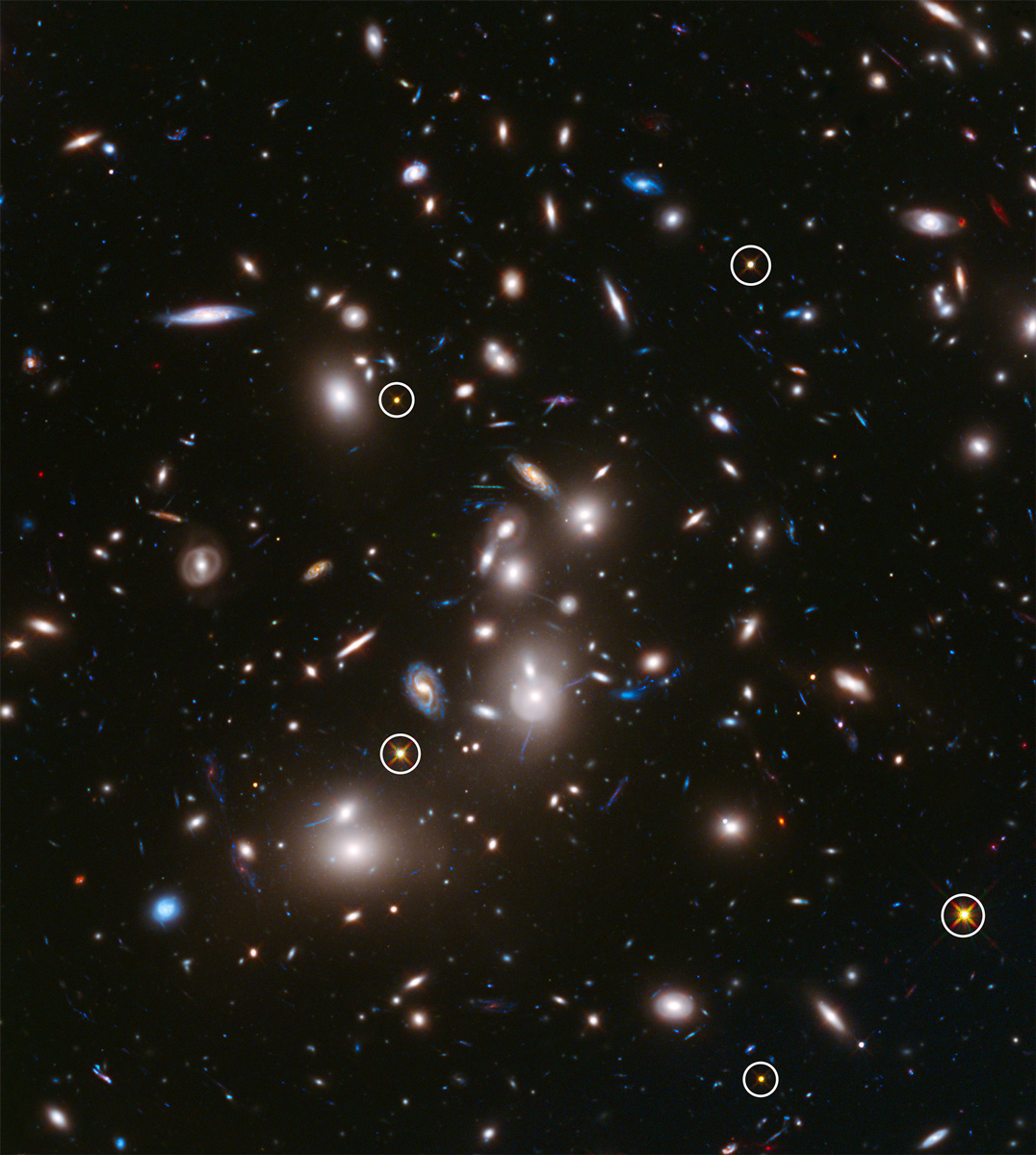
Abell2744-annot-stars

Foreground Galaxies

The green circles here capture galaxies that reside in the space between us and the Abell 2744 galaxy cluster. These galaxies are not affected by the gravitational lens – only galaxies behind the cluster are distorted and magnified. If you look at them, you see that their shapes are generally sharp, distinctive and recognizable. There aren’t many of these galaxies – the Frontier Fields project deliberately sought out galaxy clusters that didn’t have a lot of other objects in the way of Hubble’s view.

Abell2744-annot-foreground

Cluster Galaxies

The yellow circles enclose the galaxies of the Abell 2744 galaxy cluster. These galaxies vary a lot in size, from dwarf galaxies a thousandth of the mass of our Milky Way to monster-sized central galaxies up to 100 times more massive than the Milky Way. Since the clusters are colliding, these galaxies are interacting with one another – each galaxy’s gravity is affecting the other galaxies, though the galaxies that are closest to one another affect each other more strongly. Some galaxies contain greater concentrations of mass than others, and thus have stronger gravitational effects – and make for stronger gravitational lenses.

Abell2744-annot-clustgals

As we go on, you’ll see that some of the lensed galaxies in this image appear less or more warped than others. This is because the distribution of the cluster’s mass is uneven, and thus the bending of space-time is uneven. Think of it as looking at objects at the bottom of a lake – the surface of the water is uneven, so some of the objects are more distorted than others.

As a side note, astronomers can actually study the distortion created by gravitational lensing to get an idea of how mass – both visible matter and the invisible dark matter — is distributed within the Abell 2744 galaxy cluster.

Strongly Lensed Galaxies

Now you’re seeing galaxies that are behind Abell 2744, and affected by the cluster’s gravitational lens. The light of these blue-circled galaxies is shining through the cluster, and is clearly distorted in many cases. In fact, many of these galaxies look like lines, streaks and arcs. They’re often concentrated along the same lines, and many of them have similar color schemes – blue with red patches.
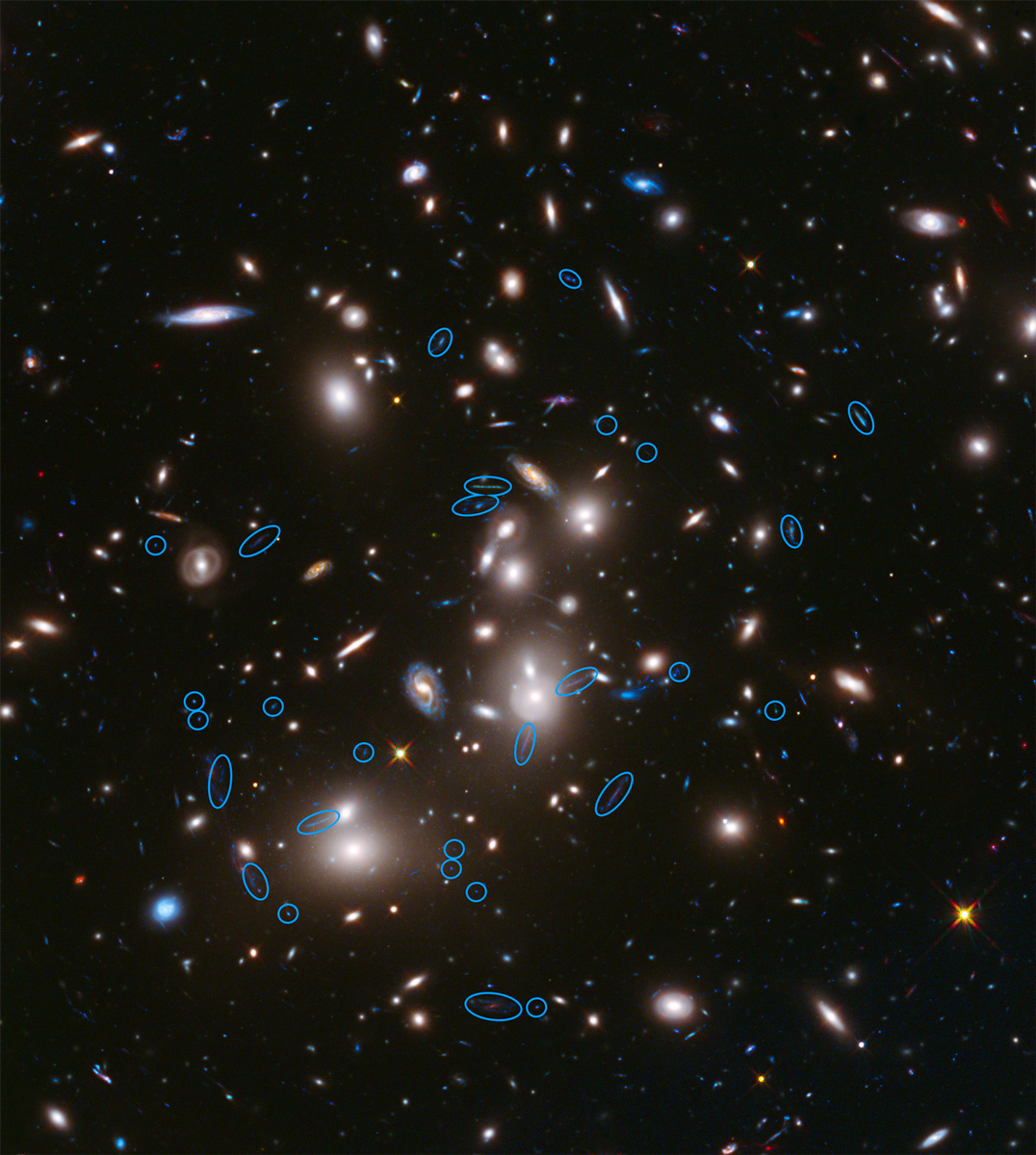
Abell2744-annot-stronglens

Some of these objects are actually the exact same galaxy, because the gravitational lens breaks the image up, as though we were looking through a very strangely shaped piece of glass. This brings us to …

Weakly Lensed Galaxies

These magenta-circled objects are galaxies that are still behind the gravitational lens, but are not strongly distorted. You see distinctive galaxy shapes, like spirals. Their light is still being magnified and brightened, but they fall in an area where the bumpy pane of glass in our earlier metaphor is smooth. They are not as magnified as the strongly lensed galaxies.
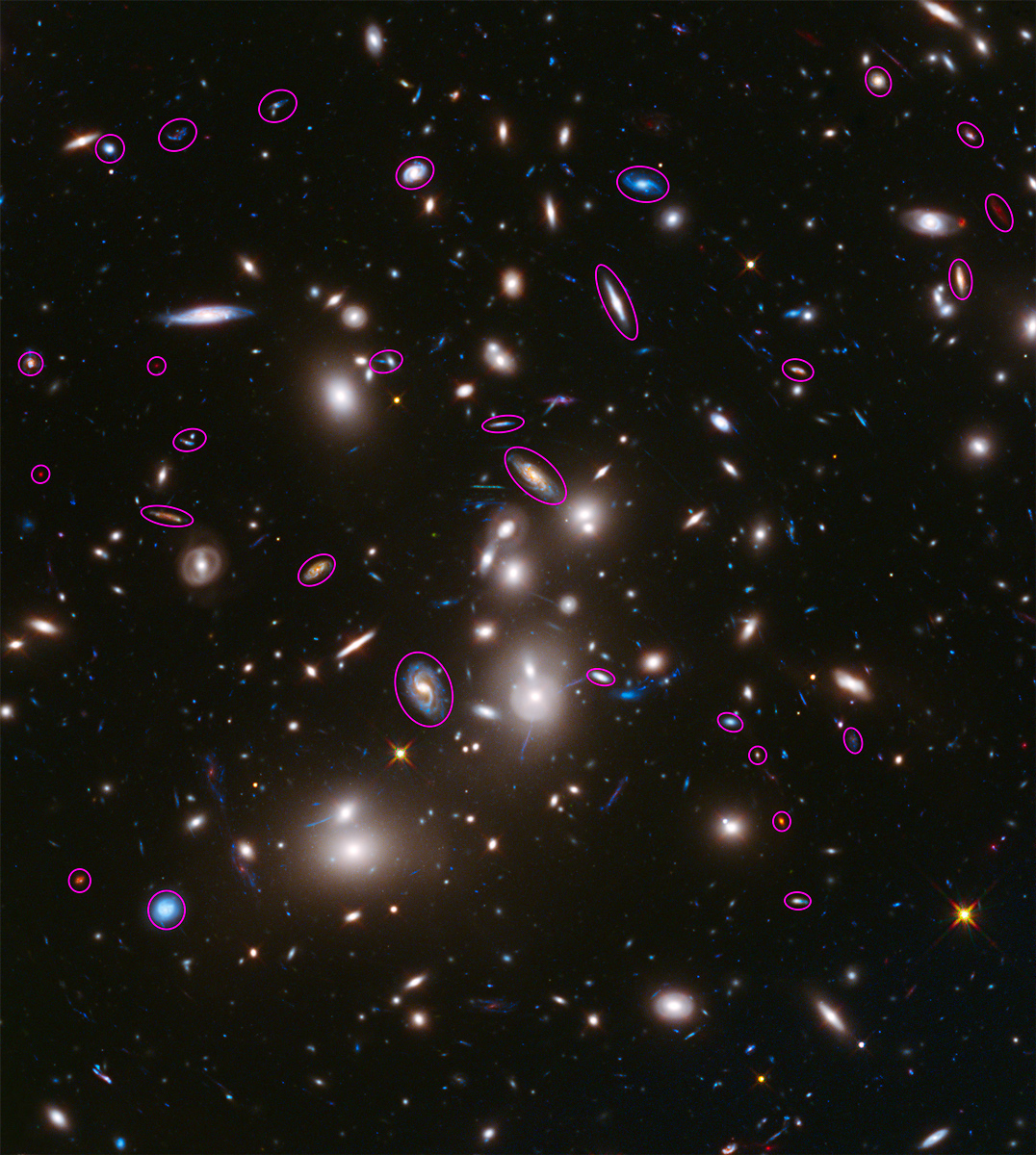
Abell2744-annot-background

Distant Galaxies

The tiny red specks circled here don’t look like much, but they’re actually some of the most intriguing objects in the image. These are the farthest and faintest of the galaxies being magnified by the gravitational lens. Their light could be reaching us from so far away that we see them as they appeared in the early universe – as far back as just millions of years after the Big Bang. (In a universe that’s 13.7 billion years old, that’s extremely far indeed.) One of these objects, Abell2744_Y1, is a candidate for being the most distant galaxy discovered in this image.
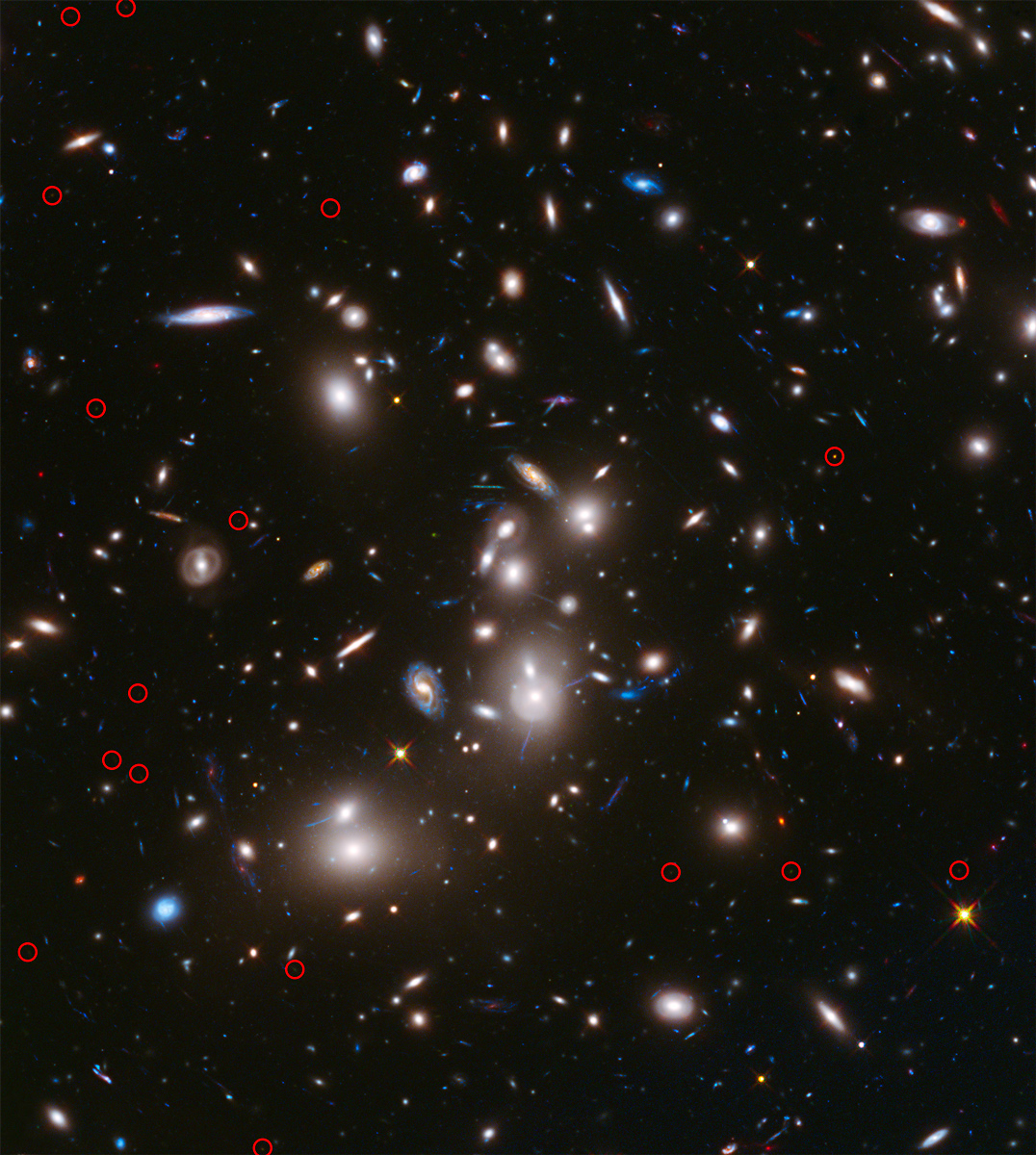
Abell2744-annot-hiz

What is Dark Matter?

hs-2010-37-b-web_printOne of the most novel aspects of the Frontier Fields project is the innovative way in which the Hubble Space Telescope is being made more powerful — without adding a single piece of equipment or changing a single hardware component.

While Hubble itself isn’t altered physically in any way to allow us to peer farther than we ever have into the universe, these observations wouldn’t be possible without one crucial component: dark matter.

Frontier Fields is turbocharging Hubble by looking at the distant universe through gravitational lenses that boost the signal from the feeble light of remote galaxies, essentially making Hubble a more powerful telescope.

For the amateur astronomers out there, these gravity lenses are like adding a Barlow lens to the eyepiece of Hubble.

What creates these gravitational lenses?

Matter, and lots of it.  Thanks to the theory of general relativity, we know that space-time is warped by stars, planets, galaxies, black holes — anything with mass. The light bends as it travels through this warped space-time.

This is exactly what ordinary lenses in a telescope do with light:  they bend it. Hence the term “gravitational lens.”

In order to make a decent gravitational lens that will show you the most distant galaxies in the universe, you need lots of matter.  Among the largest collections of matter in the universe are of galaxies.  Hundreds of billions of stars all grouped together can bend a lot of space-time (and they do). What could be better?

A lot of galaxies all grouped together, otherwise known as galaxy clusters.

We’ve written before about the galaxy clusters that the Frontier Fields team will observe throughout the course of the survey. They were chosen because they made good gravitational lenses.

But while the galaxies in these clusters do have lots of stars in them — hundreds of billions in each one — stars actually are not the major factor contributing to the bending of space-time around the clusters.

The largest contributor to the creation of those gravitational lenses is something we can’t see, smell, taste, hear, touch or interact with in any way: dark matter.

This stuff is all over the universe —  in fact, there is five times more of it in the universe than there is ordinary matter.  Everything we can see in the cosmos — stars, planets, comets, all life on Earth, anything that’s made up of atoms — constitutes roughly 5% of the total matter and energy in the universe.  Dark matter makes up about 24%.

121236_NewPieCharts720

Composition of matter in the universe. These numbers have been revised somewhat by the Planck Space Telescope. More info here. Credit: NASA/ESA

It’s usually at this point the astute person starts asking, “If dark matter won’t interact with us in any way, how do we know it’s there?”

The answer is simple enough. We know dark matter exists because we can see its effects on those things we can see.  We were first tipped off to dark matter in the 1950’s by the motions of galaxies. We noticed that if we added all the mass of all the stars inside of galaxies, something wasn’t right.  The galaxies didn’t rotate the way they should.  Their motions suggested that something else had to be there mixed in all the stars we could see.

What’s more, the galaxies that were gathered together into clusters were short on mass. If just the mass we could observe was all there was, the clusters would fly apart. There wasn’t enough observed mass to make them stay together.

This stuff, whatever it was, was making galaxies rotate as if they had more matter than we could see and was also holding galaxy clusters together.  In astronomy, we are used to investigating celestial objects by the light they emit, reflect, or block. We called this strange new discovery dark matter because it does not interact with light — though clearly it has a gravitational field we can detect.

We’re starting to get pretty good at estimating where the dark matter is in galaxy clusters. We can even make maps of it.  Here is a map of dark matter around the Abell 1689 cluster, home to thousands of galaxies and trillions of stars.

hs-2010-37-b-web_print

Dark matter in the massive galaxy cluster Abell 1689, located 2.2 billion light-years away. The cluster contains about 1,000 galaxies and trillions of stars. Hubble cannot see the dark matter directly. Astronomers inferred its location by analyzing the effect of gravitational lensing, where light from galaxies behind Abell 1689 is distorted by intervening matter within the cluster. Credit: NASA, ESA, and Z. Levay (STScI)

Astronomers have gone so far as to map where most of the dark matter is in the universe. Here’s a graphic showing the distribution of dark matter in the universe.

hs-2007-01-a-web_print

This three-dimensional map offers a first look at the web-like large-scale distribution of dark matter. The map reveals a loose network of dark matter filaments, gradually collapsing under the relentless pull of gravity, and growing clumpier over time. Credit: NASA, ESA, and R. Massey (California Institute of Technology)

Most astronomers believe that dark matter is concentrated in and around small clusters of galaxies.

For the purposes of the Frontier Fields Survey, dark matter plays a crucial role. Without it, these galaxy clusters would have less mass, and space-time would bend less significantly, creating a weaker lens.  By using these powerful natural lenses, the Frontier Fields project will enable Hubble to see galaxies about 10 times deeper than the Ultra Deep Field, the current record holder for the deepest image ever taken.

And that corresponds to 40 billion times fainter than what the human eye can see.

Now the next question you may be asking is, “What’s this dark matter stuff made of?” Astronomers are actively researching that question, but that’s a post for another day — so stay tuned!

Hubble Observations: From the Ground to Your Computer

This post is the second in a two-part series.

In my last post, “Hubble Observations: From the Sky to the Ground,” I wrote about the route Hubble images take as they are digitally transferred from space to the ground.

This is the story of what happens after that data makes the 30-mile trip over land-lines from NASA’s Goddard Space Flight Center in Greenbelt, Md., to the Space Telescope Science Institute in Baltimore, Md., and ultimately to your computer as iconic Hubble pictures.

Hubble generates approximately 855 gigabytes of new science data each month. That’s the equivalent of an 8,550-yard-long shelf of books. Astronomers, in turn, typically download six terabytes of data monthly from this growing archive. That would be the equivalent of the printed paper from 300,000 trees. By the beginning of April 2014, Hubble data had been used to publish more than 12,000 peer-reviewed scientific papers.

The raw Frontier Fields data are available to the public immediately from a repository called the Barbara A. Mikulski Archive for Space Telescopes, or MAST. However, these data are not the beautiful, color Hubble images we have come to know and love. Raw images from the telescope are black and white, and include distortions introduced by the instruments, as well other unwanted artifacts from Earthshine, occasional Earth-orbiting satellite trails, bad pixels, and random hits by small, charged particles called cosmic rays.

Cosmic ray signatures are removed by combining two exposures in a way that removes everything not in both images. Credit: NASA, ESA, and J. Lotz, M. Mountain, A. Koekemoer, the HFF Team, and Ann Feild (STScI).

Cosmic ray signatures are removed by combining two exposures in a way that removes everything not in both images. Credit: NASA, ESA, and J. Lotz, M. Mountain, A. Koekemoer, the HFF Team, and Ann Feild (STScI).


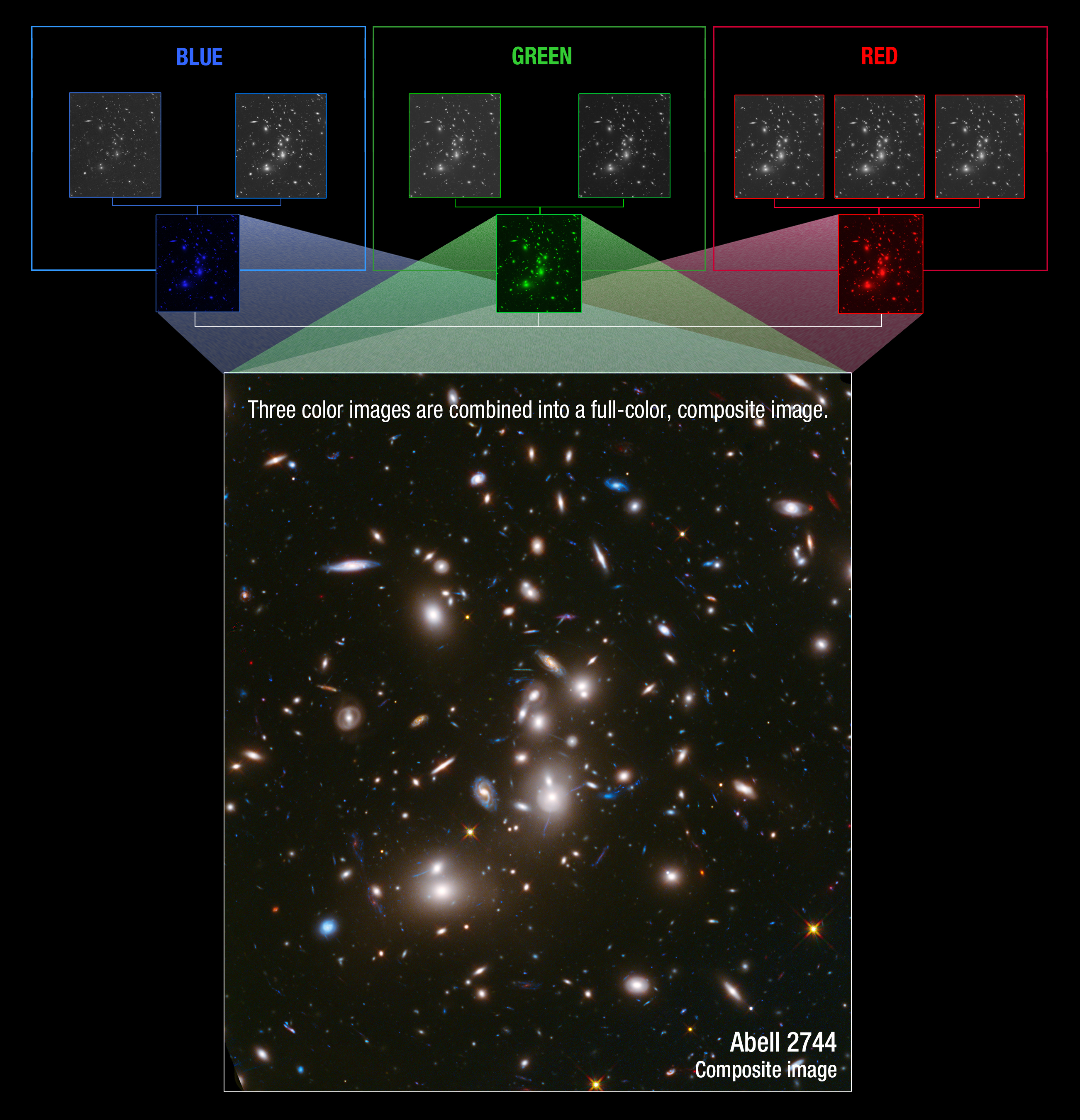
It takes a team of about a dozen instrument analysts to “clean” these images by removing the distortions and artifacts. The refined images are posted once a week on MAST. These are the combination of multiple exposures taken in seven different filters, which allow light at specific wavelengths to enter the instruments.

Hubble’s instruments have many filters. The Frontier Fields observations use four in infrared from the Wide Field Camera 3 (WFC3), and three in visible light from the Advanced Camera for Surveys (ACS). The final, deep, combined color image for each Frontier Field will have a total of 560 exposures, divided evenly between the main cluster and its parallel field.

To produce a color picture, exposures from the seven filters are assigned the three primary colors of blue, green, and red based on their wavelengths.  Images from the shortest, bluest wavelengths are assigned to blue, while images from the longest, reddest wavelengths are assigned to red, and intermediate wavelengths are assigned to green. These primary color images are then composited to produce the full-color picture so familiar to Hubble followers.

The top row shows the combined exposures through each of the seven filters as single images.  To produce the color pictures, exposures from several, selected filters from Hubble’s WFC3 and ACS were combined into one of three primary colors based on their wavelengths. The primary color images were then composited to produce the full-color image. Credit: NASA, ESA, and J. Lotz, M. Mountain, A. Koekemoer, the HFF Team, and Ann Feild (STScI).

The top row shows the combined exposures through each of the seven filters as single images. To produce the color pictures, exposures from several selected filters from Hubble’s WFC3 and ACS were combined into one of three primary colors based on their wavelengths. The primary color images were then composited to produce the full-color image. Credit: NASA, ESA, and J. Lotz, M. Mountain, A. Koekemoer, the HFF Team, and Ann Feild (STScI).

See a large collection of color Hubble images.

Amateur astronomers may want to see the raw Frontier Fields images.

There is a Facebook page  for amateur astronomical image processors to exchange information, tips and techniques, and share their work.


Hubble Observations: From the Sky to the Ground

This post is part one in a two-part series.

How does what Hubble sees become what you see? The first part involves moving science data from the sky to the ground—a complicated matter.

When Hubble views an astronomical target, the digital information from that observation is stored onboard the telescope’s solid-state data recorders. The telescope records all of its science data to prevent any possible loss of unique information. Hubble’s flight operations team at Goddard Space Flight Center, in Greenbelt, Maryland manages the content of these recorders.

Four antennae aboard Hubble send and receive information between the telescope and the ground. To communicate with the flight operations team, Hubble uses a group of NASA satellites called the Tracking and Data Relay Satellite System (TDRSS). Located in various positions across the sky, the TDRSS satellites provide nearly continuous communications coverage with Hubble.

Hubble’s operators periodically transmit the data from Hubble through TDRSS to TDRSS’s ground terminal at White Sands, New Mexico. From there, the data are sent via landline to Goddard to ensure their completeness and accuracy.

Goddard then transfers the data over landlines to the Space Telescope Science Institute in Baltimore, Maryland for processing, calibration, and archiving. There, they are translated into scientific information, such as wavelength and brightness, and ultimately into the iconic images that have become the hallmark of Hubble.

We’ll discuss how those images are made in a future post.

Image Credit: Ann Feild, STScI

Image Credit: Ann Feild, STScI