Visual “Proof” of General Relativity

In a previous blog post, “Einstein’s Crazy Idea“, I discussed how Einstein’ s theory of general relativity is a reinterpretation of gravity. Newton’s original idea of gravity visualized it as a force between massive objects. Einstein instead surmised that the presence of mass warps space, and that curved space-time produces the motions we attribute to gravity. Earth’s orbit around the Sun is either a curved path through flat space (Newton) or a straight path through curved space (Einstein).

Both ideas of gravity produce the same observed motions for most cases. But there are a number of situations, generally involving very strong gravitational effects, where general relativity explains phenomena that gravitational forces get slightly wrong. The differences are often subtle and take quite a lot of explanation to appreciate. However, one example is visually obvious: gravitational lensing.

Galaxy Cluster Abell 1689

Hubble image of galaxy cluster Abell 1689, showing a large number of lensed arcs (click on the image for larger version). These arcs are distorted images of background galaxies, gravitationally lensed by the mass of the cluster.

The above image of galaxy cluster Abell 1689 is a prime example of gravitational lensing. Throughout the image are numerous small arcs, streaks, and strange-looking objects. Most of these are relatively normal galaxies (a few really are just strange-looking objects), whose images have been stretched and twisted by the galaxy cluster and general relativity.

The combined mass of the thousands of galaxies in the cluster (and their associated dark matter – a topic discussed in the What is Dark Matter? blog post) heavily distorts the space-time around the cluster. Light from more distant galaxies passes through that warped space. The images of those distant galaxies become distorted as if they were being seen through an odd-shaped glass lens. In fact, the physics of light redirection using gravity is entirely analogous to that using lenses. It is the optics of complex lenses, but using mass instead of glass.

Newton’s gravity can not produce such gravitational lensing. Well, to be complete, a gravitational force could produce half of the lensing effect of general relativity, but only if one assumes that photons (i.e., particles of light) have mass. Modern physics considers photons to be massless particles, and hence gravitational lensing does not exist in Newton’s version of gravity, only in Einstein’s general relativity.

For that reason, I like to say that pictures of gravitational lensing are visual “proof” of general relativity. You don’t have to delve into the astronomy, physics, or complex mathematics — just examine the image. Such distortions arise from general relativity.

Now, the visual distortions may be easy to spot, but that’s not to say that these images are easy to interpret. Just the opposite is true. I’ll provide some examples of the complexities of understanding gravitational lensing in my next blog post.

Einstein’s Crazy Idea

Total solar eclipse of May 29, 1919

One of the original plates from the 1919 solar eclipse used to measure the effects of general relativity. Click the image for a larger version, and note the horizontal lines that mark stars that were used for the measurements.

General relativity is just plain weird.

The basic idea of gravity we are taught in school comes from Isaac Newton’s “Principia” in 1687. Gravity is a force exerted by objects with mass. The greater the mass, the greater the gravitational force. The larger the distance between objects, the lesser the force ( it decreases with the square of the distance). The gravity of the Sun pulls on Earth and holds it, along with the other planets, asteroids, comets, etc., in orbit.

Not so, according to Albert Einstein in 1915. He came up with a completely new, and quite radical, alternative explanation.

Einstein’s crazy idea is that the presence of mass warps the fabric of space around it. Then, that warped space controls the motion of other masses nearby. Newton’s idea of a gravitational force is thus replaced with four-dimensional space-time geometry. Planets orbiting around stars, and stars traveling through galaxies — these are space-time distortions moving within other space-time distortions. As one famous description puts it: mass tells space how to warp, while warped space tells mass how to move. Yeah, weird.

On the face of it, Isaac and Albert are just describing the same phenomenon from two different points of view: the former sees a force, while the latter sees geometric distortions. And, since the algebraic equations of the gravitational force are so, so, so, so, so very much simpler than the tensor calculus of general relativity, why go to all the relativistic trouble?

The answer is that there are certain situations, generally involving very large masses, where Newton’s gravity is demonstrably wrong. The most famous of these is the precession of the perihelion of Mercury.

The orbit of Mercury is not fixed in space. Each time Mercury orbits the Sun, its orbit rotates by a minuscule amount. The position when Mercury is closest to the Sun, called perihelion, is used to measure this orbit rotation, called precession. While Newton’s gravity predicts a precession of the perihelion of Mercury, the measured value is significantly higher. This mismatch between prediction and observation is resolved by Einstein’s general relativity in that the warping of space at such a close distance to the Sun produces a slightly stronger precession than gravitational force.

The other famous demonstration of general relativity is the bending of light as it passes a massive object. Light rays also have their paths changed by passing through warped space. A total solar eclipse on May 29, 1919, served to test this effect. During the eclipse, astronomers could see stars whose light had passed close to the Sun. Their apparent position on the sky would be shifted from their normal position due to passage through the warped space around the Sun. By observing the precise positions of such stars both before and during the eclipse, astronomers measured the effects of general relativity. (See the image accompanying this post.)

Those 1919 observations did much to confirm that this crazy idea of general relativity reflected the reality of the universe. We now have many tests of general relativity. Most are subtle and require significant explanation. However,  there is one that is visually striking, and which is critical to the scientific underpinnings of the Frontier Fields project. I’ll address that in my next blog post ( Visual “Proof” of General Relativity ).


Frontier Fields Q&A: Redshift and Looking Back in Time

Q: What do you mean when you say you’re “seeing some of the earliest galaxies in the universe?” How does looking into deep space allow you to look back in time?

The simple answer is that light travels and the universe is huge. Light travels very fast – 186,000 miles (300,000 km) per second, but it still has to move across the vast distances of space. Remember that for us to see anything – from the flash of a camera to the glow of a really distant galaxy, we have to wait for its light to strike our eyes.

That camera flash shows in our vision instantaneously because it doesn’t have far to go. But distances in the cosmos are so vast that it takes light a long time to reach us. The light from our closest companion, the Moon, takes about 1.3 seconds to cross the 239,000 miles (390,000 km) between us. So when you look up at the sky, you don’t see the Moon as it currently is. You see it as it appeared 1.3 seconds ago.

This is so 1.3 seconds ago. Credit: Luc Viatour, Wikimedia Commons

This is so 1.3 seconds ago.
Credit: Luc Viatour, Wikimedia Commons

The greater the distances, the greater the time difference. Light from the Sun needs about 500 seconds, or about eight minutes, to reach us from 93,200 miles (150 million km) away. Light from Neptune needs about four hours to cross the solar system.

We refer to these distances by the time it takes light to cross them. So Neptune is four light-hours away, and the Sun is 500 light-seconds away. Light from the next nearest star, however, needs four years to reach us across space. We say that star is four light-years away. The light we see from that star in today’s sky is also four years old. For galaxies, we’re talking millions to billions of light years. So we see the farthest galaxies as they appeared in the early universe, because the light that left them way back then is finally reaching us just now.

Q: What does it mean when you talk about a galaxy’s redshift?

When we’re discussing the Frontier Fields project, we’re talking about something more precisely called “cosmological redshift.” The space light is traveling through is expanding. That means that the light wave gets stretched as it travels, like a spring being pulled into a different shape. This stretching shifts light into longer wavelengths.
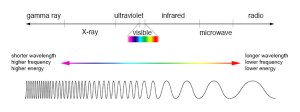
Since red light has a longer wavelength than blue light, the light is said to be "red-shifted." Credit: NASA

Since red light has a longer wavelength than blue light, the light is said to be “redshifted.” Credit: NASA

The farthest galaxies in the universe would have originally emitted visible and ultraviolet light, but since that light has been stretched as it travels, those galaxies appear to us instead in the form of infrared light. Cosmological redshift refers to that change and the measure of that change.

Q: Why do we hear the Frontier Fields galaxies described in terms of redshift and light-years? Which is right?

They tell us different things. Light-years are a measurement of distance defined by the time it takes light to travel in a year. But distance is notoriously difficult to measure in astronomy.

Cosmological redshift is a direct measurement of the expansion of space. Astronomers describe galaxies in terms of their redshift because unlike distance, it’s a clear and definite value that’s relatively easy to measure without many errors.

Astronomers have different models of how the universe works, and they can plug the redshift into those models to get the distance to a galaxy – but the distance will differ depending on which model of the universe they use. The variations in those models include things like the shape of the universe, the rate at which it’s expanding, the amount of normal matter it contains, etc.

Astronomy is about figuring out how the universe works and narrowing down all those models to the best one, and we still have a long way to go. Projects like Frontier Fields will help us rule out those models that don’t fit the incoming data.

Q: Everywhere we look with the Frontier Fields project, galaxies appear to be moving away from us. Does this mean we’re in the center of the universe?

No. It’s evidence that space is expanding. The easiest way to visualize this is to imagine a balloon. If you cover the balloon with dots, and then inflate it, no matter which dot you pick to represent your position, all the other dots will appear to be moving away from it as the balloon expands. Imagine this happening in three dimensions instead of on a flat surface, and you can understand why it looks like other galaxies are rushing away.

Q: So space is expanding and the light from the earliest galaxies has traveled over 13 billion years to reach us. If space is expanding, are those galaxies even farther away now?

Yes. For nearby galaxies, the expansion doesn’t make much of a difference. But for galaxies extremely far away, the distance is significant. That’s because the farther away an object is, the more space there is between us and the object. That in turn means there’s more space to undergo expansion, so the objects appear to be moving away from us much faster. Light from the earliest galaxies may have traveled 13 billion years to reach us, but those galaxies could be around 45 billion light-years distant by now.

Q: Does this mean the galaxies are moving faster than the speed of light?

No. No object can travel through space faster than the speed of light. But the expansion of space itself is not so constrained – in fact, theories of the beginning of the universe visualize the initial expansion of the Big Bang happening with unthinkable speed. But because the speed of light is only so fast, there are galaxies in the distance whose light we cannot yet see. We call this the edge of the visible universe.

Q: What’s out there, past the edge?

Space dragons! Ok, probably not. Credit: Uranometria

DRAGONS! SPACE DRAGONS! GIANT, COSMIC FIRE-BREATHING SPACE DRA– Ok, fine, probably not. Credit: Uranometria, Wikimedia Commons

We expect more of the same, though this is still an open question that astronomers are researching and theorizing about. We’ve found we tend to see the same distribution of galaxies no matter which direction we look in the universe. If we were somehow transported to a galaxy on what, for Earth, is the edge of the visible universe, the border of the visible universe would move, but the universe would neither change nor look very different to us.

Q: Do you have a question about the Frontier Fields project?

Leave it in comments, and we’ll see if we can answer it.