The first Hubble Frontier Fields observations of a galaxy cluster and adjacent parallel field are complete, and interesting results are starting to arrive from astronomers. In this post, we explore how astronomers used the tools available to them to piece together the discovery of a very distant galaxy.
The Discovery
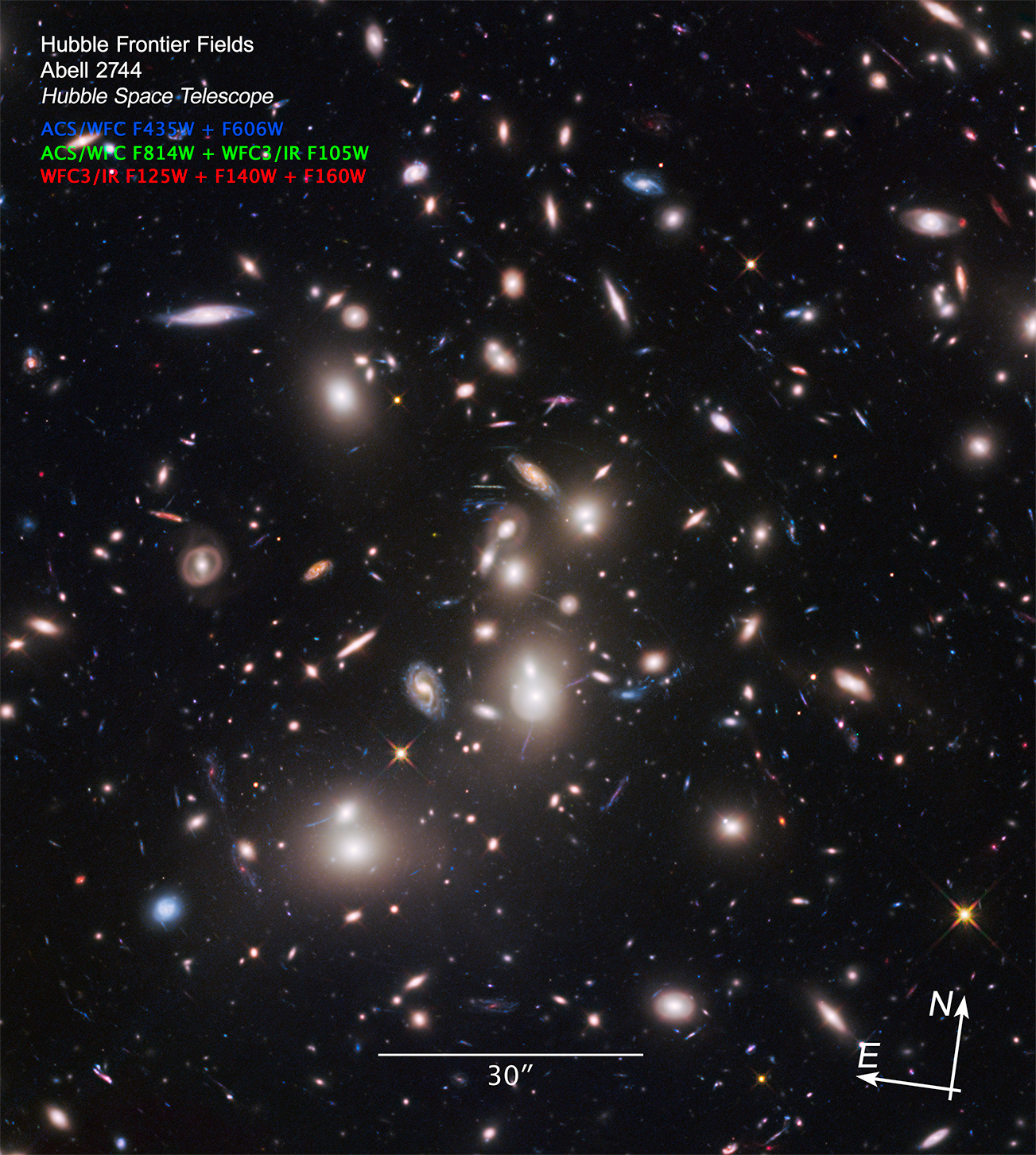
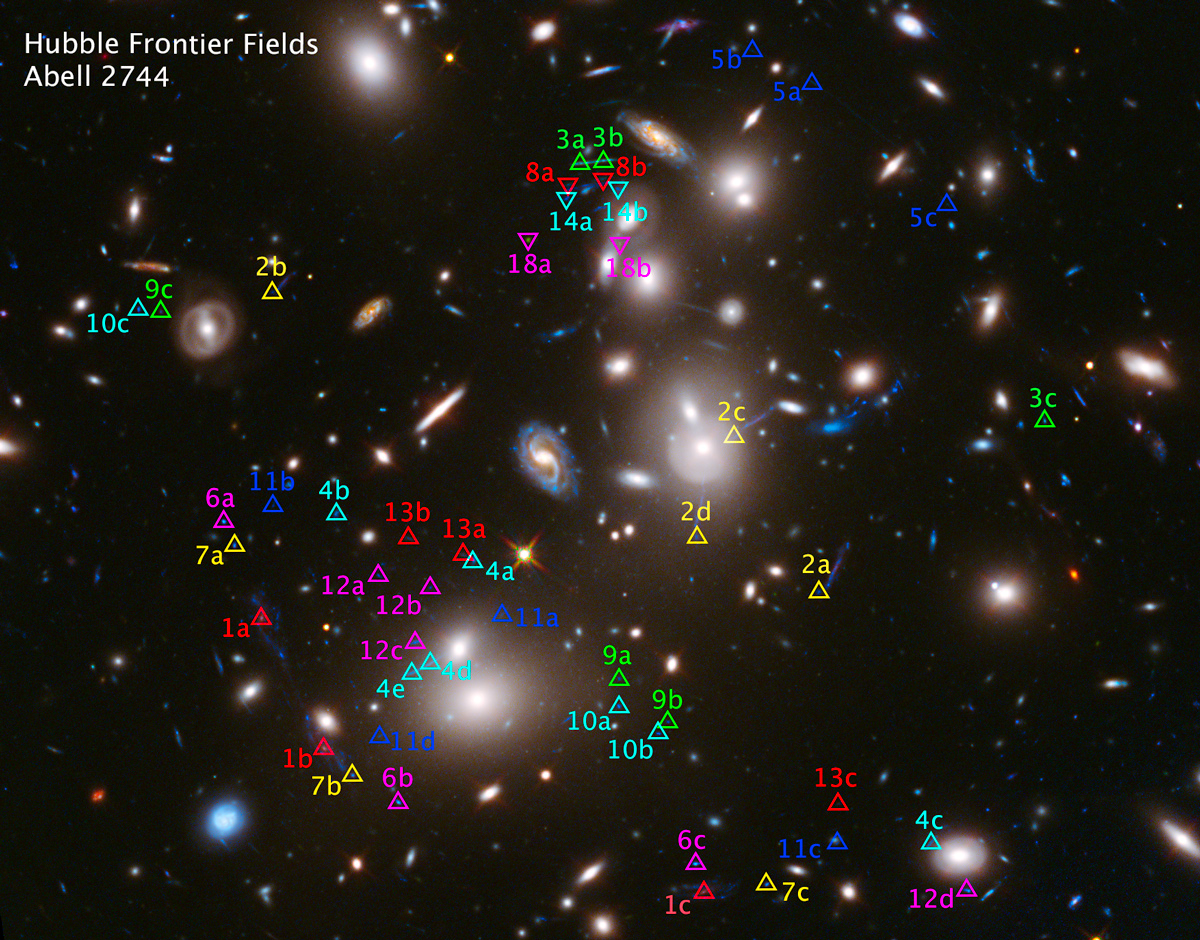
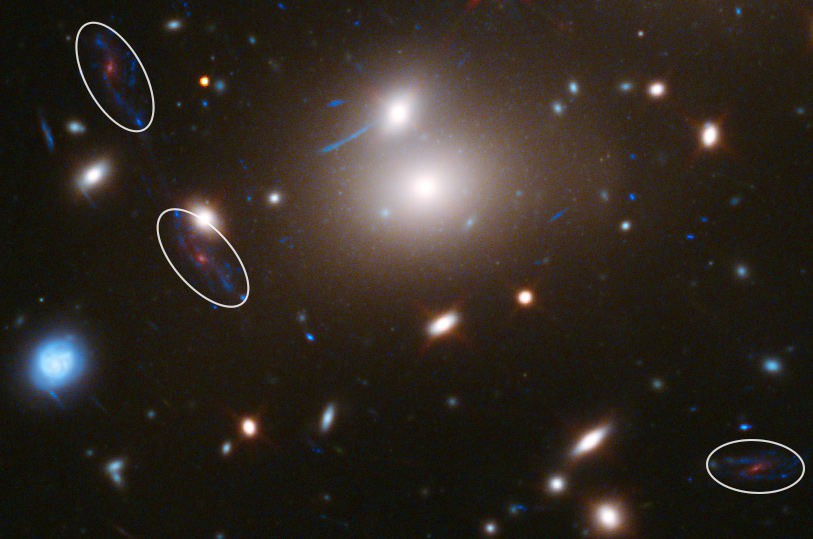
A team of international astronomers, led by Adi Zitrin of the California Institute of Technology in Pasadena, Calif., have discovered a very distant galaxy observed to be multiply lensed by the foreground Abell 2744 galaxy cluster. The light from this distant galaxy was distorted into three images and magnified via gravitational lensing of Abell 2744. This magnification provided the astronomers with a means to detect the incredibly faint galaxy with Hubble.
Astronomers are interested in finding these very distant galaxies because they represent an early stage of galaxy formation that occurred just after the Big Bang. Light from this galaxy has been traveling for quite some time. We are seeing this galaxy as it existed when the universe was only about 500 million years old. For context, the current age of the universe is around 13.8 billion years old.
Like visitors to a nursery, astronomers can see this baby galaxy is much smaller than present-day adult galaxies. In fact, they measure it to be about 500 times smaller than our own Milky Way galaxy. This baby galaxy is estimated to be forming new stars at a rate of one star every three years. That is about 1/3 the current rate of star formation of our own Milky Way, but keep in mind that this infant galaxy is much smaller than the present-day Milky Way. This baby galaxy is not just small but also a lightweight. It has the mass, in stars, of only about 40 million suns. Compare that to the Milky Way, which has a mass of several hundred billion suns. It is also one of the intrinsically faintest distant galaxies ever discovered.
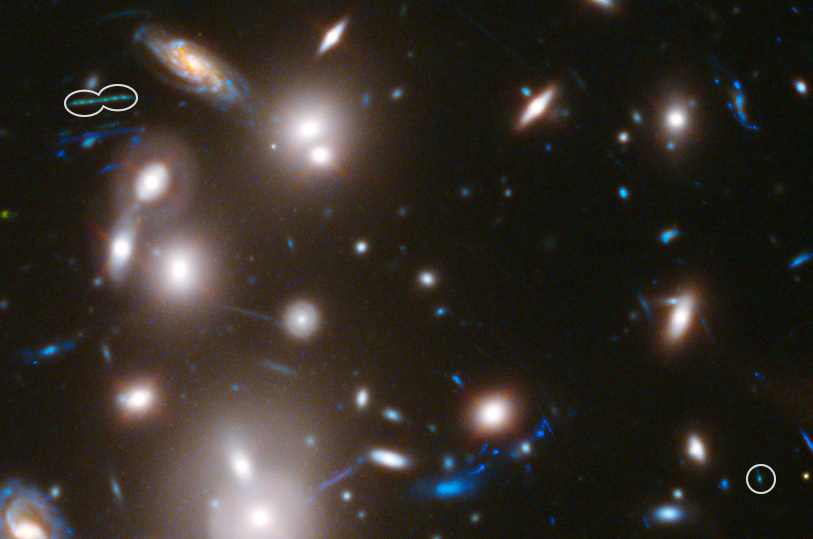
The three lensed images of the baby galaxy are highlighted in the composite image below.

Credit: NASA, ESA, A. Zitrin (California Institute of Technology, Pasadena), and J. Lotz, M. Mountain, A. Koekemoer, and the HFF Team (Space Telescope Science Institute, Baltimore, Md.) Shown is the discovery of a very distant galaxy, triply lensed by the foreground galaxy cluster Abell 2744. The distant galaxy’s lensed images are labeled as a, b, and c.
This is now one of only a small handful — about 10 — of galaxies we have discovered at such great distances. The way the team discovered this distant galaxy is, perhaps, as interesting as the galaxy itself. The team of astronomers used a traditional color-based method for determining that the galaxy is a candidate for being a distant, baby galaxy. They then followed up with a pioneering new technique to confirm the distance via the geometry of gravitational lensing.
Using Colors to Find Candidate Distant Galaxies
Why do we think that the galaxy is very far away? Astronomers used Hubble’s filters to capture the light from this baby galaxy in several different colors. The intensity of light coming from the galaxy at different colors can give an estimate of the galaxy’s cosmological redshift. Cosmological redshift, commonly denoted by the letter “z,” is a number that signifies how reddened a galaxy is due to the expansion of space. A distance can be estimated once a cosmological redshift is measured. Larger cosmological redshifts correspond to larger distances.
Adi Zitrin and his collaborators initially found the distant galaxy (labeled “a” in the figure above) by noticing that it remained when they were looking for only the reddest galaxies. Remember, a galaxy may appear red if its light is redshifted due to the expansion of the universe. The farther the galaxy, the longer its light has to traverse the expanding universe, getting more and more stretched (redshifted) along the way. Astronomers are particularly interested in finding a population of galaxies with large cosmological redshifts — values of z around 10 or greater — because they represent some of the earliest galaxies to form after the Big Bang.
From the colors of the galaxy found in box ‘a,’ the team estimated that the galaxy has a redshift greater than 4, with 95% confidence. In fact, the colors of the galaxy in box ‘a’ highly favored a galaxy around z=10, but they could not discount that what they were measuring was an intrinsically red galaxy at a lower redshift, around a z=2. How do we sort this out?
Deciphering the Geometry of Abell 2744’s Gravitational Lens
Astronomers can do better, and these astronomers have shown that with knowledge of how mass is distributed in the foreground galaxy cluster, it is possible to distinguish between higher redshift and lower redshift background galaxies. Thus, with updated maps of the mass distribution of the Abell 2744 galaxy cluster, astronomers created more precise mathematical models of how light from a more distant galaxy behaves as it passes around the galaxy cluster’s warped space.
The geometry of a gravitational lens is such that the more distant a background galaxy behind the galaxy cluster, the farther from the center of the galaxy cluster we observe the distorted and magnified, lensed versions of the galaxy. This is portrayed in the graphic below, where two lensed versions of the more distant, highly redshifted, red galaxy appears on the sky at larger apparent distances from the central, foreground, lensing galaxy cluster.

Credit: Dan Coe (STScI). Shown here is an illustration of how the multiple lensing of a background galaxy will show its maximum magnification depending on its distance to the foreground galaxy cluster. More distant galaxies will be lensed such that we observe them farther from the center of the galaxy cluster.
Astronomers can use the computed geometry of gravitational lensing to ascertain the cosmological redshift of the lensed galaxy based on its observed positions relative to the foreground galaxy cluster. If multiple images of the lensed galaxy appear nearby the cluster, it is at a lower redshift. If the multiple images of the lensed galaxy appear more separated from the cluster, it is at a larger redshift.
Finding the Multiple Images of a Distant Lensed Galaxy
With the updated mathematical models of the gravitational lensing by Abell 2744, Adi Zitrin and his team could follow up and look for multiply lensed images of the one potentially distant galaxy they had found, labeled “a” in the image at top. The mathematical models give them positions on the sky to look for the lensed siblings of galaxy ‘a’ for various redshifts. If the distant galaxy is at a relatively low redshift, multiply lensed images will appear nearer the cluster. If the distant galaxy is at a high redshift, multiply lensed images will appear farther from the cluster.
With the computational tools and mathematical knowledge available to them, the team discovered the lensed versions of galaxy “a” at positions that match a high-redshift solution. In the figure below, they marked the locations of the lensed images, labeled “B” and “C”, along with their best mathematical estimates of redshift for each of them (labeled along the blue- and green-colored redshift lines). What is labeled as the initially discovered candidate galaxy “a” in the image at top is now labeled as “A” in the image below.

Credit: Modified from Adi Zitrin et al., ApJ, 793 (2014). Shown here are the expected positions of the three lensed versions of the newly discovered high-redshift galaxy candidate, based on mathematical models of the gravitational lensing from Abell 2744. The multiply-lensed positions of the galaxy, labeled “A”, “B”, and “C,” match the high-redshift solution in the models, i.e., redshifts of around 8 or greater.
This is but a taste of how astronomers will use the Frontier Fields to combine exquisite imaging with updated mathematical models to detect and study some of the first galaxies to form after the Big Bang. We are just at the beginning of collecting the baby pictures of galaxies in our universe. Stay tuned as we detect more baby galaxies from the dawn of time!
Looking to the Future
The galaxy presented here is one of the least luminous high-redshift galaxies ever detected. This bodes very well for finding future baby galaxies in the Frontier Fields. We also expect that studies of the galaxy clusters themselves, via the new data in the Frontier Fields, will lead to more accurate mass distribution maps and more accurate mathematical models of how light from distant galaxies are gravitationally lensed and magnified.
This really is a new age in using humankind’s most sophisticated telescopes with nature’s lenses to probe deeper into our cosmic past than ever before. Stay tuned for more results from the Frontier Fields.
You can watch a Hubble Hangout of this result here!





 Frontier Fields